Our Blog

Schipperke - Una de las mejores razas para principiantes

Our Blog

Schipperke - One of the best breeds for beginners

by Lobo Azul in Mar 07 2023
This breed is not the best known in Belgium, but yes one of the nicest and one of the best for beginners, very manageable and fits anywhere, such as flats or apartments. Size: from 25 to 33 cm Weight: from 3 to 9 kilos hair type: abundant, soft and smooth Character: friendly and awake Health: good, with some hereditary diseases vine hopea: from 12 to 14 years Origins of the Schipperke When we see the schipperke we get the feeling that we are looking at a Belgian shepherd very small and this is normal, since both races come from the Leauvenaar, the ancestor of both. Its strange name means little boatman in Belgian, the country where it originates, and the reason for this way of calling it is because He went with the boatmen who crossed the Flanders canal, in charge of cleaning the boats of rodents. He also stood guard, because although due to his size he doesn't scare anyone, he is very loud, so the owners of the boats immediately knew that there was someone lurking around. There is already talk of a dog similar to this at the end of the 17th century, where the shoemakers of Brussels held exhibitions in which the animals were not judged, but rather the collars they were wearing. Legend has it that the tradition of docking the tail, now prohibited in many countries, comes from an angry shoemaker who cut off his dog's tail because he did not win the contest, something that pleased the other participants who saw that the schipperke looked very good like this. Schipperke Features We are looking at a small dog, but that does not mean that it is weak, since the FCI describes it as having a solid body and harmonious shapes. Maybe, What is most striking is its appearance, since it looks like a black skunk with a cunning look., which is what makes us distinguish this breed at a glance, even if we see one of its specimens coming from afar. The eyes are also very characteristic of an almond shape and express both kindness and tenderness, since nothing about a schipperke gives us the impression that it could be an aggressive animal. The hair is very abundant, hard and of medium length along the body., shorter throughout the head area, of a very intense black color, although parts of a fairly dark gray are allowed in the undercoat. Their most classic image is with their tail cut off, but we can now see them with it intact and they are even prettier. Furthermore, we must not forget that in many countries such as Spain this is prohibited, becoming a crime and resulting in the dog not being able to participate in exhibitions if it is cut. Character of the Schipperke He loves his owners and is always looking for the affection of his people, being very loyal to all his owners and respectful of the rules they impose on him. He is great with children, and in fact he is one of the best dogs for families., since he loves to spend time with the little ones, hiding and playing fetch or doing the same with the children, who immediately make friends with him and will adore him. Even though he is very small, and has nothing to do against a thief, he is a good guardian, as he is very distrustful, which comes from his past on ships in Belgium. He will guard objects if we ask him to, but we have to be a little careful with this, since he can do that with his toys and it will be difficult for him to leave them to us so we can have fun with him. If we live in a rural area we can not worry about rodents, since it will kill everyone it encounters, becoming a natural and ecological rodenticide. There is only one drawback and that is that he is a barker, which will cause problems in the cities, since the neighbors will soon complain. Schipperke Education Training him is very simple and it will not take him much to learn the basic rules that every dog ​​needs to master, such as coming to us if we call him, sitting, staying still, lying down, etc. That's why It is a very appropriate breed for beginners, who will really enjoy teaching it and seeing how their dog responds immediately., something that is very edifying. Furthermore, its small size makes it much easier to handle, although it is better that we do not take advantage of this when training it, for example by pulling hard on the leash if it does not pay attention, and that we use various positive training techniques. here alone He has two weak points: his barking and his love for hunting., which makes it difficult to live in a house with small pets, such as rabbits or chinchillas. You can try to educate him to bark less, although it goes against his nature and we can do the same in order to control his hunting instinct, although this is even more complicated. Regarding hunting small animals, it helps a lot if he lives with several when he is a puppy, at which time he can see them as playmates, although we should not take our eye off him. Schipperke's health He is in good health, so we will not always be at the vet if we follow some basic guidelines, which consist of seeing him at least once a year, giving him his vaccines and deworming him every three months. In any case, there are a series of diseases that are specific or hereditary, whatever we want to call them, and one of them is the dislocation of the patella, which many dogs of this size suffer from and which can usually be corrected with medication. He also suffers from eye problems, so we must check his eyes often and go to the vet if we see that he does not open one completely, the light bothers him, his eyes are red or he tears excessively. It is not alien to hip problems and there is always the possibility of developing dysplasia, something that can be avoided if we buy our specimen from an accredited breeder, who gives us proof that its parents and grandparents are free of this disease. Schipperke care Despite what it may seem from the hair, He doesn't need too many brushings and is content with two a week., in addition to a bath from time to time if we see that it is very dirty. You have to be more careful with food, because the schipperke is quite gluttonous and therefore has a certain tendency to gain weight, something that can be prevented by exercising with it daily, which will be good for us too. If despite that we see that he is gaining weight, It is best to give it a I think with a lot of fiber and talk to your veterinarian, assessing whether we should keep him that type of food as long as he lives, always purchasing it for small dogs. Adopt a Schipperke Outside of their country of origin it is difficult to find one on the street, let alone up for adoption. In this way, If we want to adopt one, it is best to go to Belgium, where it will be more or less easy to find a specimen.. Being within the EU, bringing it is very easy, since you will only have to come vaccinated and identified. If we have the opportunity to own one, we should not think about it too much, especially if we live outside the city, where its barking matters little. Other small dog breeds that may interest you: Puggle Pomeranian miniature pinscher Mal-shi dachshund Norfolk Terrier yorkshire Jack Russell Terrier Poodles Chihuahuas Maltese Bichon French Bulldog Boston Terrier Andalusian winemaker
Bobtail: todo lo que necesitas saber sobre el viejo pastor inglés

Our Blog

Bobtail: everything you need to know about the Old English Shepherd

by Lobo Azul in Mar 02 2023
At Bobtail He is also known as the “Old English Shepherd”, recognized for his extraordinary ability to lead flocks, his ability to take good care of the human family and for his peculiar appearance similar to that of a giant-sized stuffed animal. There is a peculiarity that usually delights the owners of this breed and it is their funny habit of grouping children together when they are playing in the garden, an instinct derived from its origin as a shepherd dog. In the following text we will guide you through its history, customs and behavior, in addition to offering you a complete informative guide with all the relevant information about this interesting and physically beautiful canine species. Features: Size: Large Weight: Between 27 and 35kg. hair type: Abundant and long Character: Sociable, affectionate, intelligent. Health: Little susceptible to hereditary diseases Origin In the mid-19th century, this breed was created to perform the function of helping to control livestock in the rural area of western England. It is generally believed that the Bobtail that we all know descends from dogs of Roman origin that were transferred to central Europe and that were later mixed with other English mastiff breeds. allowing the development of the Bobtail breed.  It was then in the British Isles that he received the name "Old English Shepherd", where he was extremely appreciated by shepherds for his particular ability to direct livestock, a genetic quality collected from his crossing with livestock breeds from Great Britain. There is this historical reference, but there is really no certainty as to which races were used for such a particular mixture, but given their physical characteristics, it is possible to determine that among their ancestors are the Bearded Collies or bearded collies. Learn more about another Collie breed on our blog. Likewise, characteristics of the breed Ovtcharka, of Russian origin, are found in the Bobtail.  What is completely certain is its geographical origin. The Bobtail was born from the shepherds' need to obtain dogs suitable for work tasks and that were agile and resistant. That happened in the west of England and it was in 1880 that The Bobtail breed was officially presented during a dog show. Since then, the Bobtail breed began to be recognized by the Kennel Club association, the organization that is responsible for the classification of dog breeds worldwide, having since then and for posterity, a clear record of the standards necessary to consider a Bobtail specimen as a pedigree breed. Currently, Bobtail lines genetically devoid of tails are already used, a peculiarity that was adopted as a standard for this breed because their tails were originally cut off. Physical characteristics of this breed The large size of Bobtail is perhaps one of the main physical characteristics of this shepherd breed. It has a height that ranges between 50 and 70 centimeters and a weight of up to 35 kg. It is very hairy, in fact it is essentially a woolly dog, therefore, its coat is generally two colors, long and wavy. Another characteristic of a Bobtail's hair is that it is usually opaque, unlike that of other breeds, which have a higher level of shine. Their fur is abundant and very thick, generally of a standard white color, in combination with large black or gray spots. A Bobtail has a large, square-shaped head with floppy ears. The expression on his face is very sweet, very similar to that of a yorkshire. The hair usually covers their eyes almost completely, and their eyes have the particularity of being blue or brown, and it is possible that some specimens have one eye of each color, heterochromia being a common trait in this breed.  They have a muscular chest and a strong neck, although it is not appreciated much due to the thick and abundant fur. A Bobtail dog gives the impression of being short and chubby, but that is only due to their coat, since underneath they have a muscular body, long and slender legs that coordinate perfectly with the size of their head. The tail of a Bobtail is usually amputated, although there are currently specimens genetically devoid of it. In fact, the meaning of his name would be “docked tail”, a physical characteristic associated with sheepdogs. The bark of the Bobtail breed is very characteristic, since its voice is penetrating and very deep, an interesting and very useful quality in a dog created for herding livestock on European farms, as the Bobtail was at the time. Character of a Bobtail Very intelligent and with great vitality, this is how we can describe the character of the Bobtail. It is a dog who loves to feel part of the family and do their job in the field. He always seems very willing to participate in the activities that take place in his home, sometimes even behaving in a manner similar to that of small lap dogs. The Bobtail is, without a doubt, a very sweet dog with a personality that anyone can fall in love with. He becomes very familiar with the members of the family and, therefore, many owners of this breed say they feel this dog is “very human.” He easily becomes friends with children and knows how to behave around them, which is why he is known in England as “Nanny-dog” because his quality of being especially sensitive with the little ones from the house and keep them under surveillance.  Bobtail breed dogs They are very loving and patient.In addition, they know how to adapt to new environments easily. Their intelligence and patience helps their owners when training and educating them, as they learn lessons quite quickly. They are perfect dogs for the home, but it is necessary to provide them with space to carry out physical activities outdoors. We must remember that it is a working dog and therefore, we cannot deny it exercise. He needs a dose of frequent stimulation, otherwise we would have a lazy and depressed Bobtail who won't even have the courage to play with the children. With good training, the Bobtail is so docile that it doesn't even require a leash to go for a walk. It is almost moving to observe the scene of a Bobtail dog with his family on their walks to the park, or walking with the children down the streets until they get to school. He is calm, playful, kind, expressive and very tender.. Recommended care for this breed Taking care of a Bobtail is not a difficult task, since it is not a breed that requires excessive special care, although it certainly has some particular requirements that must be met to ensure that it enjoys a happy life.  First of all, the Bobtail They need a constant physical exercise routine: jogging, taking a long walk or playing ball or any other sport is essential. So if you are a sedentary person, you should avoid committing yourself to breeding a Bobtail dog. On the other hand, if you are a person who likes outdoor activities, perhaps you are the right owner for an Old English Shepherd. The ideal thing for raising a Bobtail is that its adoptive family has a house with space available for its recreation, since it tends to get very bored in small spaces. Of course, he can adapt to living in an apartment, as long as the owner understands that he must have time to take him out for a walk at least twice during the day. Lack of exercise leads to episodes of depression, anxiety and stress in the Bobtail breed, since they prefer the freedom of life in the countryside, running outdoors. It is necessary that they exercise to avoid muscle atrophy.  Other essential care for this very striking and particular breed are the following: Food. The diet of this dog should be based on feed that is formulated for the requirements of this breed in terms of protein value, vitamins and minerals suitable for the maintenance of its coat, etc. The daily calorie consumption of this animal is 1400 Cal, otherwise it will lose its muscles. Bathroom. A dry bath routine is enough for them, and eventually a wet bath with a special shampoo for their coat type, always with the appropriate products. Daily brushing. Bobtails need their coat brushed and groomed as a daily routine, so you should avoid this breed if you do not have the time or patience to meet this need. Training. This is a care and a necessity in this species, since it allows them to develop a full life, learn to adapt to the family routine and obey the orders of their masters. How to train a Bobtail puppy Training a Bobtail dog is not as complex as it may seem, in fact, it is much simpler than with other breeds, since it has a genetic predisposition to work and follow orders instinctively, which comes from its past as a sheepdog. Of course it requires a little patience, because this dog has its own sense of humor and can get playful and disobedient when you try to get your Bobtail to learn something. However, it is easy to train and he will show his patience every time you try to make him learn a lesson. Everything will depend on your attitude and the training technique you decide to apply. The docility of the Bobtail is great to learn, because they can even get used to staying dressed in the most peculiar outfits, which families with children usually love.  They are tolerant of their environment and They learn from a very young age to adapt. As they are trained, they even learn to recognize the general moods of the home and understand routines, so that they will not disturb the family when they sleep. Now, all of this is learned, you cannot make the mistake of believing that just because they are a Bobtail breed they do not need to learn obedience and discipline. The Bobtail is an intelligent dog and, therefore, it is your responsibility to reinforce those behaviors that you consider correct and teach the behavioral patterns you want from your pet. The way he acts and behaves during visits to the house, the way he will act in front of children and how he will interact with others of his kind are matters that are under your complete control if you decide apply strategies to train it properly. A daily routine is something that is highly appreciated by the Bobtail breed because order is something that makes their lives much simpler and happier. You must teach him to relieve himself in a single point in the house, how he should eat and the speed at which he should do it, when to exercise and what type of activity and be attentive and available during grooming moments, which are necessary for the maintenance of his coat. Health care Bobtail dogs usually enjoy good health and a life expectancy of more than 10 years, but their owners must provide the conditions and the necessary care to ensure that they grow up happy and their health lasts. The Bobtail is not prone to developing hereditary diseases, being a fairly resistant breed. Of course, like any other canine, it has some common ailments that should be tried to prevent.  There are three key points that need to be covered to care for the health of a bobtail, and they are as follows: Dental hygiene. A tooth in good condition needs cleaning, in this way the development of periodontal disease that can cause the loss of teeth is avoided, which affects the quality of life and diet of the Bobtail. Coat care. The daily brushing routine should be complemented with a monthly haircut that removes the hair from your eyes, so as to avoid the accumulation of waste in the area and the occurrence of infections. Vaccines and deworming. Once you adopt a Bobtail you assume responsibility for its vaccination schedule and deworming schedule, so that it can deal with the diseases and infections to which all dogs are prone. Bobtails are quite prone to external parasites such as ticks and fleas, which is due to their abundant and thick coat type. Additionally, there are six diseases that Bobtails are often exposed to and that must be taken care of: hip dysplasia Wobbler syndrome Diabetes Deafness Falls Stomach torsion  Bobtails have a certain genetic predisposition to these diseases, but they can all be avoided by providing a daily canine routine that includes all the basic breeding criteria for this breed, which is what can guarantee them a full and satisfying life with their adoptive family. Prevent non-hereditary diseases such as barking cough and leishmaniasis is just as important to ensure the health of your pet. Curiosities of the Bobtail breed There are some curious facts that you probably didn't know about this dog breed that is friendly and ideal for family life. Its original name is “Old English Sheepdog”, which translates as “Old English Sheepdog”, but it became known throughout the world as Bobtail, a word that means “Short Tail”, because it was a norm to dock the tail of sheepdogs. During World War I (1914-1918) Bobtails were used to drag sleds with supplies to the battle front, while by World War II (1939-1945) the breed almost became extinct. It has a high caloric intake, needing a diet that provides 1,400 Cal per day to ensure the quality of its muscles and that its weight remains within the appropriate weight standards as corresponds to the Bobtail breed.  There are also two sub-breeds of cats that have the same name, Bobtail, but with different variations: American Bobtail and the Japanese Bobtail. This is a dog that, due to its good education, is very easy to train to be used in the world of entertainment, which is why since 1960 it has made constant appearances in film and television in Australia and the United Kingdom, also starring in many advertisements, including spots for a wide variety of dog food. Finally, the fur and the eyes are its most curious features, since heterochromia is common in this breed, therefore many puppies are born with one eye brown and the other blue. Their fur does not vary much either, only having a color palette that only includes white, black and gray, abundant and very long. Throughout this guide we have taught you a series of valuable information for raising Bobtail puppies, which will allow you to know if this breed is the one you need for your life or if you already have it, get valuable advice for its care. Information designed to help adoptive families of this beautiful and intelligent dog breed. Find out about the care of other breeds such as: Czechoslovakian wolfdog. German Shepherd Akita inu chow chow Cane Corso Argentine Dogo Great Dane Saint Bernard Neapolitan Mastiff Rottweiler Doberman Labrador Retriever  
Enseña a tu perro a arrastrarse o gatear

Our Blog

Teach your dog to crawl

by Lobo Azul in Feb 28 2023
There are several tricks that we can teach our dog, with which we will show off to our friends and have fun for a while, in addition to feeling very proud of the animal when everyone is staring. One of them is crawling or crawling on the ground, a movement that is not natural in dogs, but that they can learn in a very simple way with a little work and some rewards. First you have to learn some previous orders We cannot begin to teach the command “crawl” without first having memorized some previous commands, such as sit and stay, which are even easier to teach, especially if we do it when they are puppies. In any case, an adult dog can also learn them, just like crawling, although it will cost us a little more and we must be more patient, repeating the sessions and making them somewhat shorter. How do we teach him to crawl? We have to go to a quiet place where the animal has no stimuli that distract it., like a room in the house, our garden, a park without many people, etc. There we give him the order to sit and then to stay still. Immediately, and without waiting too long so as not to tire the dog, what you have to achieve is to direct it towards the ground. We can do it in several ways, either with the command “lie down” if you know it, although it is more spectacular if you do it from a sitting position, so when he is like this we show him a treat that we will not give him if he gets up. Getting your attention We make him look at his favorite snack and we move him to the floor, with the idea that he lies down on his own., but when he does it we are not going to give him the prize, because we want him to crawl. Therefore, we have to distance ourselves a little by showing him the candy. If he crawls on the ground we say “crawl” and then we reward him. This must be repeated several times without tiring him, starting again the next day until he starts crawling when we ask him to, always giving him his reward if he does it well, at the right time when he starts crawling. The clicker can be useful to us, a tool that is nothing more than a sheet of metal that makes a sound, after which we reward it. It is used a lot in positive training, since the dog associates the “click” with a stimulus and will be aware of the clicker, which helps it to be focused on the training and not be distracted by anything. At first it may be a little difficult. Just start It may be a little difficult for him to crawl, since what he will do is get up and come running when we show him the prize, which should not be given in this case. As he does it wrong, our dog will realize that it is not what we expect of him, so he will begin to crawl towards us, perhaps a little at first and getting up, although he will understand as soon as he does it a couple of times and receives his reward. Depending on the breed, it will be more difficult to assimilate it, but it is not a complicated exercise and any dog ​​can do it if we set our mind to it. We can complicate it a little by giving the order remotely When the dog already crawls without failing on most occasions, which means that he has the trick under control, we can take it a step further and complicate it. For this What we have to do is add distance when we give the order. This means that we ask him to sit and stay, we move a few meters away and then we tell him to crawl. With this, what we achieve is that the distance it travels attached to the ground is increasingly greater, making the trick more spectacular, although always with caution and only letting it do it for a few meters, because we do not want our dog to get hurt. After a while, it will no longer be necessary to give him a treat, although it is advisable to do so from time to time and congratulate him profusely, give him his favorite toy, etc., all so that the dog understands that we are very happy with what he has done. It helps keep your head busy. In addition to showing off, teach him this trick It will serve to keep your head busy, since there are several breeds that need it, such as sheepdogs and all those that are very active. On many occasions, some of these dogs end up in shelters because their owners do not know how to give them what they need, which is nothing more than spending time with them and teaching them tricks of this kind, with which the animals enjoy and occupy their brains learning. Other training tips: When should I reward my dog? What should I do if my dog ​​eats too fast? 5 advantages of training our dog with positive reinforcement Discover Agility How to train a puppy Tips for walking your dog correctly 10 basic commands that your dog must learn
Basset Hound - Descubre este singular perro de caza

Our Blog

Basset Hound - Discover this unique hunting dog

by Lobo Azul in Feb 21 2023
The Basset Hound It is a hunting breed highly appreciated for its tracking abilities for hunting.. Due to their low profile and small stature, these dogs are often overlooked. However, they make the perfect hunting companion for humans, forming lasting friendships and displaying extreme levels of obedience. Here you will find all the information you need to know more about this unique and adorable breed. Size: 35 to 45 cm Weight: between 25 and 45 kilos hair type: short and smooth Character: friendly and familiar Health: delicate although it seems otherwise Life expectancy: between ten and twelve years Origins of the Basset hound France and England dispute the origin of the basset hound, but the truth is that this breed was born in the French country, as the first part of its name tells us, which means small in French. It is possible that it comes from the Normandy region, since the artesian basset of Normandy It has a lot to do with its origin, although it also carries the blood of strong-bodied hounds like the Saint Hubert Dog. For a time he was the best bloodhound in France, so in the end he ended up being taken all over Europe. This is how it ended up in England, where we have documented its arrival at the hands of Lord Galway in 1866, who took a pair to the island, which gave rise to the first litter of basset in this country. It seems that in the end the English took it over., since even in its standard it appears as of English origin, forgetting that it is French and that it was there where it originated from crosses with hounds. Basset hound characteristics The appearance of this dog is unmistakable, so even if we do not know the breeds, we know that we are seeing one, many people calling it "dachshund", although this name corresponds to the dachshund, which has a similar appearance, although more graceful. This breed has a very long body that is supported by very short legs., with a straight back that makes it elegant in its own way. Although it may seem small to us, the truth is that it is very robust, as it can weigh more than 35 kilos and measure up to 40 cm at the withers in the largest specimens, which gives it a friendly but disproportionate appearance. He has a huge head with wrinkles and a large dewlap, his upper lips falling down, covering his lower ones, with huge ears that fall to the sides of his head and almost touch the ground. His expression is something that has also made him famous, as the lower eyelid is drooping and shows part of the conjunctiva. So, When he looks at us he seems sad, melancholic and serious. The coat tones are a combination of white, black and tan, with a distribution of colors that is unique to each basset hound, accepting the colors that the hounds have without the need for them to be positioned in a specific way. The hair is straight, very dense, hard and short, protecting it in the field from spikes, brambles and plants. Character of the Basset hound This is a family dog that loves to be with the members of its pack and play with children, who must be warned not to pull its ears, otherwise it may have a bad reaction if they hurt it. The serious face has nothing to do with his personality, because He is a fun dog to play with and walk around the countryside., preserving its hunting instinct, so we will have to be careful when we go out into open spaces. At home he gets to live well with other pets if we have had good socialization since he was a puppy, and it is advisable that he have a few toys so that he does not get bored. Basset hound education He has a reputation for being stubborn, which has been earned hard, so it is always advisable to insist a lot on obedience training, despite the fact that it is not going to pay attention to us immediately as if it were a shepherd dog. Luckily, he is very smart and that means he learns quickly, especially if we use positive training techniques such as the clicker, using food when rewarding him, which will make him be more than attentive. It is a hunting dog, specifically one that follows trails, so it is not unusual for it to get distracted as soon as it smells one and go after it, so you must always be attentive and reinforce the call, the order to stop, etc. In any case, training is not complex and it is a good dog to start with if we like its appearance, as long as we are willing to let it ignore us a little at times. Basset Hound Health It is not the best among dogs and The truth is that we can classify him as having poor health.. This is largely due to its unnatural appearance, which means it has to pay a certain toll in the form of illnesses or diseases. The spine is long and the weight is high, so you can suffer from back pain, which is worse if you are a little overweight. We appreciate this, because suddenly he doesn't want to climb stairs or has a hard time getting to the sidewalk. Also sgastric torsion pain although it is not too big. In order to prevent it, you must be careful when feeding it, since it is an acute disease that can lead to death if you do not act quickly. Thus, it is better to distribute the food in several daily feedings and leave time between food and the walk, or between the arrival of the walk and the time to feed it. Hip dysplasia can appear, more due to its weight than its height, and the appearance of herniated discs must be prevented by educating it from a young age so that it does not jump in order to get on a sofa or on top of someone. It seems that the list of problems does not end, and because of the way his eyelids are (and because of heredity) pconjunctivitis may appear (it is a mild illness) and glaucoma, which can leave you blind if you don't act soon. Finally, and with this we close the health section, the basset hound has a tendency to gain weight. If we see that you begin to gain weight, we can give him a light feed, always talking to your veterinarian first. Basset hound care He needs a lot of exercise to distract himself and so that he doesn't gain weight, but nothing that has to do with jumping like Agility, which is very harmful for this breed. The best thing is to go for a walk in the countryside for as long as we can and let him play with other dogs, something he loves. Their hair is easy to care for, as a couple of weekly brushings are enough. Yes, you have to be more attentive to the blemishes and drool, which will have to be cleaned as they appear. We finish with the ears. The interior must be checked frequently, since being always covered it is quite common for them to have otitis, something that we will realize when seeing them walk with their head tilted.   Adopt a Basset hound Unlike other races, It is not uncommon to find a basset hound to adopt. At the end of the hunting season they are usually seen in animal shelters, and we can even ask the hunters, who sometimes want to give away some dogs that are not suitable for that activity. If we adopt one, we must take into account that they are delicate dogs, which means that they need us to spend money on them both on good feed and on visits to the veterinarians, which can be frequent. Furthermore, We must not forget that they are a little stubborn, so it is possible that you have to educate him so that coexistence is the best and at least he obeys on most of the occasions when we ask him to. Other medium dog breeds that may interest you: Belgian Pasture golden retriever border collie Labradoodle Ibizan Hound Harrier english bulldog Boxer Schnauzer english bulldog Beagle Andalusian winemaker
Bullmastiff: alimentación, carácter, cachorros, precio y mucho más

Our Blog

Bullmastiff: food, character, puppies, price and much more

by Lobo Azul in Feb 16 2023
It's not a Bulldog or a Mastiff...it's a bullmastiff!!! one of the most balanced dogs that exist according to the opinion of experts and qualified trainers in the world. From previous centuries This breed of dog was preferred by rangers and landowners to confront and neutralize illegal hunters and those who lurked in the regions where they lived without becoming violent. A firm, obedient, protective and affectionate dog at the same time. If you decide to adopt or buy one, here we will tell you everything you need to know: from its breeding to the price at which it is valued in the current market. Keep reading and you will know how take the best care of your Bullmastiff. Size: Giant. Weight: Between 45 and 55kg. hair type: Short, smooth and hard. Character: Intelligent, calm, sociable and affectionate. Health: Healthy Life expectancy: Between 8 and 12 years. History of the Bullmastiff The Bullmastiff It is a breed that became known as such in the 19th century, but its origins come from the 13th century. It is native to Europe, specifically Great Britain, and from there it spread to the Iberian Peninsula and other regions of the continent. Their crossing arose from the need of the English gamekeepers to have a dog that could chase the poachers who stalked the forested regions and who illegally entered the private lands of the large landowners, usurping the existing fauna.. An illegal activity that had become a big problem and that due to the cunning of these poachers was not ending. So it was thought to search a canine guardian that was big and strong like the Mastiff and at the same time agile and cunning like the Bulldog, without being aggressive, but also very obedient. From this crossing the Bullmastiff was born, and the results were surprising, since its keen sense of smell to track its prey over several days, together with its great resistance and strength, made it Bullmastiff the ideal dog for this work of surveillance and protection. At first the name that this breed received was “Gamekeeper's night dog«, which in Spanish translates as “Ranger Night Dog”. It is worth mentioning that, although it is a breed originating in the United Kingdom as described in the records, its existence was already known in Spain under the name “bull dogs”, and proof of this are the oil paintings by the Spanish painter Goya, which date back to 1800, and by Manuel Castellano, from near later dates, where you can see these specimens with the appearance very similar to what they have today. Another breed of dog that is also English is the Bobtail dog., and you can read about it on our blog. Physical characteristics of the Bullmastiff The Bullmastiff is a big dog but not giant. It is within the category of dogs known as molossoids for his great muscular and robust build. According to the FCI classification, it is classified in Group II. Due to their characteristics, they perform very well as guard dogs, but at the same time, if they are raised correctly from puppies, They become very affectionate with their masters and with the rest of the family members.. Height In males the average height is between 60 and 70 cm and females are a little shorter, usually between 60 and 65 cm. It reaches its maximum height around 3 and a half years. Weight Males are thicker and heavier than females, as in other similar dog breeds. Males weigh between 50 and 60 kilos and females weigh between 45 and 55 kilos. Head and snout Wide, robust and square in shape with folds. The snout is short, wide and square in appearance. The truffle is round and has open windows. eyes and ears His eyes are medium-sized and dark, squinted. Deep looking. Their ears are small, drooping and triangular; Darker in color than the rest of the fur as well as its snout. Body He has a vigorous body. With a short and very straight back that becomes more robust, wide and muscular towards the back and chest. Deep chested. Queue Long, high and strong insertion. Mouth The Bullmastiff is a breed of dog that drools a lot. There are no records of the type of bite of these dogs since it is not a dog trained or used to bite but to knock down and immobilize its adversary. Its lower jaw is wide. With large canines and strong teeth. Fur Short, smooth and hard. Light brown (beige), red or brindle in color. It usually has a white tuft on its chest. This type of coat is ideal for withstanding extreme weather conditions. Black marks on the face are always present regardless of coat color. Life expectancy Between 8 and 12 years old, but everything will depend on the care and nutrition we provide. Despite being a dog that may appear fearful at first sight, it is very calm, reserved and always on alert. It is very docile and protective of his masters and it is always calm. He inherits from the Bulldog that friendly and protective treatment towards children, so if you leave him alone with them they will not run any risk. Despite being a large dog, he likes and feels comfortable living inside the house, to which he adapts without causing any damage. The only thing you should know is that he needs routine walks to make him feel happy and to keep him in good shape.   Personality The Bullmastiff He is a very brave dog and nothing upsets him or scares him, on the contrary, he inspires a lot of confidence. In front of strangers they are very calm and not aggressive at all.. They are not dogs that bark much either, there must be a very big reason for the Bullmastiff to start barking, and his bark is loud and even his hair stands up in the face of imminent danger, but the rest of the time he is silent. And if, by chance, an intruder invades its territory, like a good hound it will detect its presence and will not bark to scare it away, rather it will seek to knock it down and neutralize it without attacking or biting it until waiting for an order from its master. If you have a Bullmastiff you will know that what we tell you is true. A small weakness that the Bullmastiff presents is that they are not very friendly with other dogs, over whom they seek to impose themselves and dominate, so at the time of their training their socialization process with other dog breeds is important so that they maintain the same balance that they present to people. Bullmastiff Feeding A large dog like the Bullmastiff needs a good quality dry food that helps him perform the functions of watchdog and protector very well. Feed him twice a day. Use foods from brands that contain an adequate balance of proteins with an adequate supply of vitamins, minerals and enzymes. We tell you this because an excess of protein would be counterproductive, especially when it is in its growth stage, since it can cause problems in its joints. Prevents you from becoming overweight at any age. Daily portions vary depending on your Bullmastiff's life stage. Up to 5 months of age, portions should not exceed 400 grams per day. Up to 8 months, provide portions of up to 500 grams daily. At one year, portions should not exceed 550 grams and from 12 months onwards you should reduce portions to 400 grams again. We do this to find the right weight and not have an obese pet, but rather a healthy, agile and happy dog. You can add raw foods in small proportions such as beef. They also serve tongue, beef heart, and combine it with salt-free foods such as spinach, celery, broccoli, carrots and cauliflower, which will provide those vitamins that dry animal foods often lose in their preparation process. When you supply them, you defrost them and supply them at room temperature in small pieces. Natural foods should be supplied little by little and with the knowledge of your veterinarian. Also, do not combine the two types of food at the same time. Don't forget that dry foods cause more water intake than natural foods, so if you choose to give natural foods you will see that the amount of urine decreases. The water should be changed daily and the containers cleaned to avoid the presence of germs and grease from food waste. Avoid eating too quickly during feedings, as this can lead to episodes of hiccups caused by swallowing air. Health To complete its optimal state of health, you should brush it two to three times a week and bathe it every 15 days with a neutral shampoo. Combine its care with 2 or 3 moderate walks daily. In general, the Bullmastiff does not usually have hereditary diseases. However, it is advisable that you have it protected against diseases that affect dogs such as canine respiratory complex or cutaneous leishmaniasis. The first thing you should know is that you should not acquire a Bullmastiff less than two months old, since its lactation process is very important and if it is weaned before completing this process it does not have those nutrients that breast milk provides. Puppies These puppies are very naughty and can be clumsy with children due to their status as puppies, so don't think that the dog appears to be a threat to the smallest members of the family, but it is an indication that they need training from 6 weeks old. Since we do not want an obese puppy, since the fact that it is “chubby” is not a sign of good health, you should feed it with a dry food with an adequate balance of proteins, cereals, vitamins and calcium, ideal for large breeds in growth stage. Don't forget to be strict about vaccination control and keep in touch with your veterinarian more than twice a year. Yes you adopted a Bullmastiff as a pet…Congratulations!!! You have made a great choice. If, on the other hand, you are interested in buy a copy of this breed The price varies depending on the kennel, age, sex, training and nutrition received. Buying a Bullmastiff At the time of purchasing it you must know who its parents are, as well as their health status and the kennel of origin. The price of a bullmastiff with a pedigree and all its regulations up to date It varies, but the cheapest is around 300 euros. From then on the price can reach up to 1300 euros. A female specimen for breeding is available at an average price of 500 euros. There are those who offer a litter of 3 copies online at a price of around 750 euros. As you will see, this breed of dog, if you are really interested, needs a large investment, but we assure you that you will not regret having done so. Another reference that may be of help to you is the age at which you acquired this copy. A Bullmastiff approximately 50 days old (with its pedigree and vaccination card in order) can be purchased at a price of 800 euros. Also the price of a puppy already dewormed, vaccinated and with a health guarantee, you can get it for a price of 900 euros. A 5-year-old specimen is sold at a price of 500 euros. Conclusion In conclusion, The Bullmastiff is an exceptional dog, especially for living with the family.. Although it is a dog classified as a guard, the truth goes further, and is that it is an excellent companion. His loyalty to his owner and to the rest of the family members makes him an adorable pet. If you are willing to have a partner and have them give birth to a litter of these specimens, you will not imagine the moments of happiness you will have. Despite its robust and firm appearance, it has a very sweet character, and especially for the little ones in the house, with whom they will not waste hours of entertainment and care for them. Dare to acquire a specimen of this breed and share with us your moments of happiness and experiences. Other giant dog breeds: Cane Corso Newfoundland Tibetan Mastiff Rhodesian Great Dane Akita Inu Argentine Dogo Kangal Persian Shepherd Saint Bernard  
Puggle - Descubre sus características, salud y temperamento

Our Blog

Puggle - Discover its characteristics, health and temperament

by Lobo Azul in Feb 14 2023
In recent years, and in case there weren't already enough dog breeds, It has become fashionable to create new ones by hybridizing two existing ones, as is the case of the puggle., which is already registered in some organizations in the United States. Size: from 20 to 38 cm Weight: between 7 and 14 kilos hair type: short and smooth Character: affectionate and intelligent. Very balanced Health: good, but prone to some diseases Life expectancy: from 12 to 15 years Origins of the Puggle Although it is a very recent breed, the truth is that we do not have much data on the creation of the puggle, although we do know that The first record dates back to 1980, when Wallace Havens baptized the breed. This occurred in Wisconsin, in the United States. This country is usually the cradle of these latest experiments with breeds with an uncertain future, since they do not have a standard and the FCI It does not usually recognize them nor do we believe it will do so in the medium term. To obtain the breed (we will refer to the puggle in this way, although it is not) They were used in beagle and pug. Due to their difference in sizes, and in order to make delivery simple, the female is a beagle and the male a pug, otherwise the female pug would have a very difficult time giving birth. Puggle Features It is a small dog, which in this aspect is more similar to the pug than the beagle and whose size ranges from 20 to 38 cm, with a weight of between 7 to 14 kilos. As we see, The size and weight data are variable and this depends on which genetics predominate, whether the beagle or the pug., so the puggle can resemble any of them. Of course, the body is almost always that of the pug, very small, compact and with very short legs, with a snout that is either short or elongated, again depending on which of the two breeds it most resembles. The hair is short and straight, dense, with black, lemon and white tones, brown with fawn, etc., although any mix is allowed when dealing with a mixed animal and being a puggle, a cross made between a beagle and a pug, whatever the result. Its appearance is very similar to that of the small street dogs that have always existed in the towns of Spain, especially if the snout is more similar to that of a beagle than that of a pug. When he has the pug's snout, the appearance is somewhat comical, especially the expression, since it seems that that face does not match that body. Puggle Character If there is something good about the puggle, it is its character, being a very affectionate and sociable animal., so it is suitable as a first dog, even if you do not have experience, as it will be a good school for any owner. He can live with both adults and children, although he must always be accompanied, since he is very attached to his owners and does not tolerate loneliness well, at which time the dreaded separation anxiety may appear. A trait that defines its character is adaptability, since it is not a demanding dog in this aspect. This means that you will live just as well with an elderly person in a small apartment in the city center as in a country house with many children. He only needs affection to be happy and some exercise, which does not have to be very intense, which the puggle is not going to ask of us either, since several daily walks in the park are enough for him. The only drawback that can be made is that he tends to bark excessively., something that will have to be worked on if we live in a building with neighbors, who will soon complain about this aspect.   Puggle Education Puggle education should always be positive, as it makes no sense to use harsh methods or be very firm with such a small dog, although we must avoid overprotecting them. It is a sensitive animal that immediately seems afraid or starts crying., something that should not make us over-indulge him, and we will scold him when he touches like any other dog. Its training is not complicated, since it is a very sociable animal and attached to its owner, in addition to being very smart. Thanks to this character, it will not be difficult for us to teach him basic obedience, things like coming to the call, sitting, lying down, staying still, etc. We may have problems when training him so that he does not bark, so it is advisable to work with him from a very young age, giving him treats when he stops if we ask him to. Here you will have to be patient, since It is difficult to lower the level of barking to an acceptable level.. In any case, if we see that from a very young age he is already out of control in this aspect, we can turn to a professional trainer. By working as the professional tells us and using some tricks, we will get him to bark less, which is important if we live in a flat or apartment and even less so if we live in a house in the country or in the town. Puggle Health Mixed-breed dogs always have better health than pure breeds due to genetics, but when two breeds are mixed, as has been done to create the puggle, there is a risk that the result will be prone to inheriting the diseases of each of their parents. That happens in the puggle, which often suffers from skin diseases such as allergies, dermatitis or fungi, so you will have to check your skin often and go to the vet if you have any symptoms, because if it is detected early it is easier to stop the problem. Otitis and conjunctivitis (the latter coming from the pug) are not rare, although they can be prevented if we clean both the ears and the eyes, checking the inside of the ears daily and notifying the veterinarian if we notice that the eyes are very red or watering more than normal. If it has the head of the pug, it may suffer alterations that brachycephalic specimens have, such as asthma or various respiratory system problems. All these diseases should not scare us, since puggles are prone to them, but this does not mean that they will suffer from them all. Furthermore, it has less chance of passing through them than pug or the beagle, and some like the conjunctivitis or allergies are normal in many dogs. In fact, with proper veterinary care, the same as that given to other breeds, it is not uncommon for them to reach 15 years of age, something that few dogs can say. Puggle Care All puggle care is quite simple, starting with the coat, which will be in very good condition with weekly brushing, without requiring further attention. Like any small dog, and in order to avoid digestive problems, It is best to give him quality feed. and specific for these animals, with the small kibble, which makes it easier for them to chew and digest it. Before we said that he was prone to conjunctivitis and otitis, some of which can be prevented by cleaning his eyes and ears, inside, with saline solution several times a week, or with specific products sold for this purpose. Lastly, It is not a dog that can be alone for a long time., otherwise he will have anxiety, so we must ensure that he spends as much time as possible with him, as he is not the ideal dog for those people who are away from home all day. Adopt a Puggle The puggle is another of those breeds that is very complicated to adopt, since there are few around the world and it is possible that in Spain there is none. Yes, it will be easier to adopt a pug and especially a beagle, a larger breed that is more often abandoned or left in shelters, especially those that come from hunters. In the event that we decide on a pug, we must know that they are delicate animals, so it is advisable to always have money reserved to be able to take it to the vet with peace of mind. Other small dog breeds that may interest you: Tibetan Spaniel Pomeranian Miniature Pincher schnoodle dachshund or sausage dog Jack Russell Terrier poodle Chihuahua Maltese Bichon yorkshire French Bulldog Boston Terrier Andalusian winemaker
Pastor Alemán: Toda la información sobre esta excelente raza de perro

Our Blog

German Shepherd: All the information about this excellent breed of dog

by Lobo Azul in Feb 09 2023
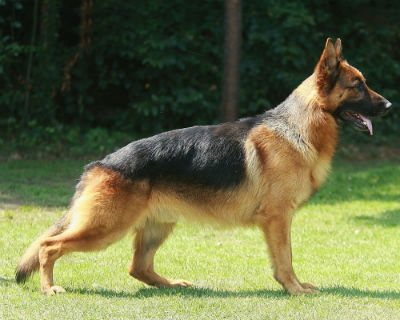
When looking at a German Shepherd, few people would think he was bred to lead and protect a flock. Most people see the German Shepherd as a police or rescue dog, a guide dog, a friend to children and a faithful companion. Although the origins of this breed were linked to herding, it has proven to be a versatile and intelligent dog. Today he continues to carry out this type of activity, but he is also chosen and trained to help man in various tasks such as those indicated above. Features: Size: Large Weight: Between 22 and 40kg. hair type: Abundant Character: Sociable, affectionate, intelligent. Health: Prone to developing hereditary diseases History and origin of the German Shepherd dog around 1880 Different breeds of sheepdogs lived in various regions of Germany. At that time, attempts were made to standardize different grazing breeds. The dogs were bred to preserve the traits that stood out in their work herding sheep and protecting them from predators. In Germany, this was practiced in local communities, where shepherds selected and bred dogs that had the skills necessary to herd sheep; such as intelligence, strength, speed and keen senses of smell. The results were dogs that could perform such tasks, but that differed significantly from one location to another, both in capabilities and appearance. To unify these differences, the Phylax Society was founded in 1891, with the intention of creating standardized dog breeds. The society dissolved only three years later due to conflicts regarding the traits that the dogs promoted by the society should have. Some members believed that dogs should be bred solely for work purposes, while others believed that dogs should also be bred for appearance. Although they failed in their goal, the Phylax Society had inspired the standardization of dog breeds uniformly. Max von Stephanitz, a former German Army cavalry captain and former student of the “Berlin Veterinary College”, was one of the members of the Phylax Society. He firmly believed that dogs should be bred to work. In 1899, Von Stephanitz was attending a dog show when he was shown a dog named “Hektor Linksrhein.” Hektor was originally from a few generations of selective breeding and completely fulfilled what Von Stephanitz believed a working dog should be. He was excited by the dog's strength and captivated by the animal's intelligence, loyalty and beauty. So much so, that he bought it immediately. He later changed his name to “Horand Von Grafrath” and founded the “Verein für Deutsche Schäferhunde” (German Shepherd Society) in 1899. Horand was declared the first German Shepherd breed dog and added to the society's breed registry. Horand became the focus of breeding programs and was bred with dogs belonging to other members of the society that displayed similar traits. Although he sired numerous offspring, Horand's most successful pup was “Hektor von Schwaben.” Hektor was inbred with another of Horand's offspring, from which “Beowulf” was born, later siring a total of eighty-four cubs, primarily through Hektor's other offspring. Beowulf's progeny were also inbred and it is from these puppies that all German Shepherds draw the same genetic link. It is believed that the society achieved its goal thanks to Von Stephanitz's firm and uncompromising leadership. For all these reasons, it is considered as the creator father of the German Shepherd dog breed. Physical characteristics of the German Shepherd dog The beauty, the affable character and the intelligence These are the characteristics that led the German Shepherd to be one of the most famous dogs of all time. The head of this dog is wide and wedge-shaped. The ears on top are medium-sized, erect and pointed, making it look like a wolf. Dark eyes, in an oblique position, convey security and confidence. The powerful teeth must be strong, healthy and complete with all 42 teeth to guarantee the power of this dog's scissor bite. You may be interested in: The Belgian Shepherd The body of the German Shepherd is longer than it is tall, the top line is slanted downwards, so the withers are higher than the rump. The chest, slightly wide, has a depth that ranges between 45 and 48% of the height at the withers and the sternum is long and well noticeable. The tail It is long and reaches the hook when at rest, but should not exceed the middle of the metatarsus. When at rest, the German Shepherd has its tail hanging down, while it keeps it elevated when active, even if it never rises above the horizontal line. The fur It has been the subject of controversy because there are three varieties. However, the official breed standard provides for breeding of the longhaired and shorthaired variety, both with undercoats. In the case of short hair, it is thick and adherent to the body and can be thicker and longer on the neck. For the long hair variant, it is thick but unlike the other variant, it is not grippy. However, the hair is expected to be longer and thicker on the neck than in the short-haired variant. The breed standard Supports multiple colors, including solid black, black with reddish undertones, and various shades of gray. The nose must be black. The height at the withers varies from 60 to 65 centimeters for males and from 55 to 60 centimeters for females. The weight of the males ranges between 30 and 40 kilos, while that of females ranges between 22 and 32 kilos. Different lines of the German Shepherd dog The breed versatility It allows different lines to exist oriented to different tasks, functions and purposes. Lines that have their own features, origins and history. Let's see what these lines of German sheepdogs are.   West German Demo Line: This is the original standard Max Von Stephanitz and the most uniform, recognizable and popular type. American and Canadian demo line: With a firm structure and lateral gait, this line is characteristic of the demonstrations of the national German Shepherd clubs of North America since the 1970s. West German line of work: Also considered the original type created by Max Von Stephanitz, these shepherds excel in guard work, rescue, herding, and as an excellent family pet. All this is thanks to an effort to correct the capacity, impulses and work structure. East German Work Line: Bred under the East German government after World War II, this line is characterized by rigid control of blood lees. They are dogs known for their temperament, soundness and excellent genetics. Czech line of work: Developed mainly for military and police work since communist Czechoslovakia, they are dogs very oriented toward defense and guarding. Character and personality of the German Shepherd dog The character and personality of the German Shepherd He is stable, confident and proud. The courage of these dogs is known to everyone, as well as their defense instinct. Given this natural instinct, they are among the most sought after dogs for defense and protection. However, it should be noted that courage and defense are not synonymous with aggression and danger. The German Shepherd tends not to trust strangers, even if there are no imminent dangers, and above all, it never attacks without reason. Obviously, correct socialization when he is a puppy is essential to avoid problems in the future, because character does not depend only on genes. It is an easy breed to train with positive reinforcement, like many other dog breeds. Thanks to its great capacity for adaptation, this breed has been successfully used in various activities. The German Shepherd excels in dog sports, as a search and rescue dog, as a guide dog, police dog or in pet therapy. And of course, he is exceptional as a companion dog. The puppy that will be part of the family must be educated with affection, but also firmly. These simple precautions are the best guarantee for a relationship of affection and friendship with an animal that asks nothing more than to put its notable qualities at the service of its owner. However, you must remember that he can be sweet and affectionate with children, but he is not always able to measure their strength. For this reason, it may not be the ideal playmate for the little ones in the house. To be truly happy, the German Shepherd needs the presence and affection of its owner. Although he looks like a pet, his working dog instinct makes him generally proactive. It will therefore be necessary to ensure that you always feel useful. You should not hesitate to spend several hours a day proposing physical activities that allow you to progress and fully realize yourself. Pregnancy and puppies of the German Shepherd dog The pregnancy of a German Shepherd dog is approximately 2 months and 7 days, that is, 67 days. During this time, constant care from a veterinarian is essential. It is advisable, especially at birth, to have the veterinarian at your side, to be able to help in case of complications. The number of puppies may vary between 4 and 10 puppies per litter. If the shepherd bitch becomes a mother for the first time, one can count on a smaller number of puppies. Two weeks before birth, the dog gets used to the whelping area. This should be well designed with blankets and soft paper, since the dog loses a lot of blood and amniotic fluid during childbirth. Starting one week before the scheduled date, the female's body temperature is measured daily. Approximately 24 hours before birth, the temperature drops to 2 degrees. The birth of a puppy consists of three phases; During the opening phase, strong contractions occur as the birth canal opens. In the abortion phase, the pup is expelled. This is followed by the placenta which the dog herself eats. It contains many nutrients and is released to the puppy through breast milk. Now comes the third and final phase of this wonder of nature. Since the puppy comes out in a small amniotic sac at birth, it is bitten by the bitch, and the pup is detached from the umbilical cord. The amniotic sac also eats it. These three phases are repeated every time a puppy is born. The time interval between the birth of 2 puppies can be from 15 minutes to 2 hours. Puppies come into the world blind and deaf. Only his sense of smell develops to find his mother's breasts. For the next 2 weeks his routine consists only of eating and sleeping. After this time, their eyes open and their sense of hearing develops. After approximately 3 weeks They get their baby teeth and become more active. A month after their birth, they begin to explore the area and learn to interact with other pets, such as cats. From the second month the socialization phase begins. Here, puppies learn the basics of coexistence. During this time, it is important to familiarize puppies with all the things and sounds of everyday life. From the eighth to the twelfth week it is gradually withdrawn from breast milk. As the puppies are able to take solid foods and are no longer dependent on the mother, it is the ideal time to separate mother and puppies. The new owner must ensure that the dogs have been vaccinated or dewormed. There must also be a veterinary certificate of health status. One of the most well-known typical breed diseases in German Shepherd dogs is hip dysplasia. It is a hereditary disease that leads to serious disorders of the hip joint and the posterior musculoskeletal system of the dog. When choosing the puppy, pay attention to whether it has a healthy self-esteem, is curious and shows good alertness. Additionally, puppies should have a healthy distrust of anything new. Anxious animals are not suitable for use as a service dog. Female dogs are generally quieter and more reserved. At the age of approximately 3 months, the puppies move to their new home. From here you start with the education and training of the dog. Contact with other dogs is very important to learn social behavior. How to feed a German Shepherd dog Adequate nutrition from the first months of life is crucial to ensure that your German Shepherd develops good health. When you acquire a puppy, it must eat alone and be completely weaned. The age of the puppy should never be less than 3 months. You may be interested in reading: How to feed a puppy: tips and tricks The first tip is to ask the breeder what food they used for weaning and possibly give us a sample, in order to provide our dog with a familiar food to avoid problems with the change. Especially during the growth phase it is important to provide a nutritious, adequate and well-balanced diet. The German Shepherd, like all dogs, is primarily carnivorous. Some foods that are necessary for us can harm you or, in the best of cases, do not create any type of nutritional principle. For this reason it is advisable to choose a good feed like the one in the entire range. Blue Wolf, suitable for human consumption and based on top quality raw materials for 100% natural nutrition. The German Shepherd is a dog that, like many medium and large dogs, can be subject to certain diseases. With good nutrition you can reduce the risk of suffering from them and ensure optimal health for your pet. German Shepherd Dog Care The German Shepherd can get used to living in an apartment, but in this case he will need a lot of walks and exercise to strengthen his muscles. Having a garden helps, but it doesn't have to completely replace walks and play sessions outside the home. Allow him to practice a sport for dogs, as it helps him drain accumulated energy and stay in shape. Training is also useful in helping you develop your intelligence. Taking care of the German Shepherd's coat is not very difficult because it is not necessary to cut it frequently. However, since he tends to shed a lot, brushing him every day is very important. You should not bathe him often to avoid damaging the natural protection of the coat. You may be interested in: How diet influences your dog's hair Health and diseases of the German Shepherd dog Unfortunately, the great popularity of the breed has encouraged indiscriminate breeding for purely commercial purposes. Indiscriminate breeding has had a negative impact on the health of the breed. It is for this reason that The German Shepherd is prone to developing hereditary diseases such as hip dysplasia, elbow dysplasia, digestive problems, epilepsy, chronic eczema, keratitis (inflammation of the cornea) and dwarfism. It is important to take the dog to the vet every 6 months and respect the vaccination schedule. The life expectancy of the German Shepherd is approximately 13 years. Education and training of the German Shepherd dog Since the German Shepherd is a intelligent, careful and disciplined dog, its training does not present particular difficulties. However, if you are not an expert, it is good to consult a professional. German Shepherd training should begin around 7 or 8 months. To properly train a German Shepherd, it is enough 10 lessons, during which, always accompanied by its owner, but under the orders of the trainer, the dog will learn the essential notions that will make it an educated companion. Behavior on a leash, foot calling, the habit of responding to one's own name and traditional, but no less necessary, commands. When the dog has correctly assimilated these first routines, the trainer will continue the perfecting process. First of all on the track, where the German Shepherd learns to jump, bark at a stranger, etc. Then in the field and in the forest (we must not forget that if the Belgian Shepherd is considered the sprinter on the track, the German Shepherd is more powerful in open spaces). Finally, you work in an urban area, where you will have to get used to the noise of cars, the coming and going of people, etc. In short, it will be inserted in all the environments in which it will have to develop and adapt. Then the defense exercises can begin where the trainer will instruct the dog to guard a house, a farm, defend children, etc.   [embed]https://www.youtube.com/watch?v=2MSyy3OURdo[/embed] All the trainers agree on the same message, all training must be understood as a pleasure for the animal, otherwise the result may be opposite to the desired one. In 10 hours, the young German Shepherd will transform into a balanced and effective defense dog. In fact, a guard dog should never be an aggressive dog. Contrary to popular belief, aggression is not part of the nature of this breed. The trainers' mission is to teach you to deter any malicious person, not to attack them. Only after all this can the competition begin and take on its main tasks, from a long list of roles that it supports with great success (army, police, customs, disabled people, mountain and disaster rescue, etc.). Conclusion and tips for acquiring a German Shepherd dog Always try to look for a serious and professional breeder, in order to guarantee healthy puppies with a health record and first vaccinations. You should also request a guarantee of a few months, in case the puppy develops hereditary health problems. Logically, the puppy will have to be at least 3 months old to be able to take it home. It is also preferable to be shown the parents, so you can get an idea of ​​what they will be like as an adult. When it comes to choosing the right puppy from a litter, you need to choose wisely. However, choosing the right puppy is never an exact science and requires a little attention, so as not to risk the breeder making a totally random or self-serving decision. Most people tend to base their choice simply on the physical appearance of the puppy, rather than taking the time to get to know its individual characteristics. This can lead a person to make the wrong decision. Videos about the German Shepherd [embed]https://www.youtube.com/watch?v=R3FvEjqekqU[/embed]     Other sheepdogs: Bobtail or English Shepherd Belgian Shepherd Basque Shepherd Catalan Shepherd Garifan Shepherd Australian Shepherd Bergamasco Shepherd Persian Shepherd  
¿Cuándo debo premiar a mi perro?

Our Blog

When should I reward my dog?

by Lobo Azul in Feb 07 2023
It is very common to reward our dog, as that is a way for him to know that he is doing things well, which will help us when it comes to reinforcing positive behaviors. Here we must be careful, because sometimes we don't reward the animal well, and we even contribute to unwanted behaviors without realizing it. The prize must be given immediately The prize works by association, so as soon as he does what we want we give it to him. Thus, if we are teaching him to lie down, the moment his belly touches the ground, we reward him. We do not wait a while later nor do we do it before, because the animal will not know what we want, only that we give it a reward for trying to lie down or for getting up, which will make teaching it to lie down very complicated. We must avoid reinforcing behaviors that do not interest us Let's imagine the previous scenario again. We proudly see how our dog lies down on command and when we go to give him reinforcement he starts barking nervously, or gets up and jumps towards us. If at that moment we give him his reward, the only thing we are going to achieve is that he believes that barking or jumping on him is okay, so from that moment on he will do it waiting for his treat, without understanding what is wrong if we get angry. So, It is essential to reward him only if he is completely calm, which would be when he lies down without doing anything else, staying calm. That's when we give him his favorite treat, a toy, or pet him. This is useful whenever we are teaching him something or even in daily life, when we do not have to say nice words to him, give him a caress or scratch him if he is in a state of excitement that never suits us. What do we do if he doesn't calm down? If he does not calm down, you should never resort to physical punishment, much less yelling at him as if the dog managed to understand us. It is best to ignore it. We will not pay attention to him, we will not touch him, and much less will we reward him, until he calms down and is still. In this way we will make him understand that what we want from him is for him to remain calm, since only in that situation can he interact with us. Various kinds of rewards can be used We already know when to give rewards and now we have to know which ones to use, the main ones being food. For example, There is no dog that can resist a piece of cut sausage, a cat pellet or a little sausage, although we can also buy special treats for them, which we will ensure are healthy. They sell healthy treats, made of meat or fish and only with natural products, although it is not necessary that we always reward them with food. We can also use one of his favorite toys, such as a ball or one of those in the shape of an animal that whistles, and give it to him at the same moment in which we want to congratulate him for something he has done well. It is best to vary the rewards so that they do not get tired quickly.. Therefore, in addition to the above, we can also caress him while saying words that show that we are happy with him. The amount of rewards must be reduced as the animal learns. We must not forget that rewards must be given with the idea of reinforcing good behaviors, something that is usually done when the animal is a puppy and we are educating it. Therefore, As he grows and learns, the amount of rewards must be reducedWell, we are not going to always have a snack in hand when he does something well several times a day. At the moment when the behavior we ask of him is normal for him, we can stop rewarding him so much and do it only from time to time, with a caress, a time of play or even with a little food. This will serve as a reminder to the dog that when he behaves well he receives his reward, so he will be more willing to do what we ask of him. Other training articles that may interest you: Intelligence games for dogs What should I do if my dog eats too fast? Tips to strengthen your dog's defenses 5 advantages of training our dog with positive reinforcement What are the best treats for dogs? What can I do to stop my dog ​​from asking for food at the table?
Pastor Belga: Origen, características y alimentación de las cuatro variedades

Our Blog

Belgian Shepherd: Origin, characteristics and feeding of the four varieties

by Lobo Azul in Feb 02 2023
The Belgian Shepherd, as their name suggests, hails from Belgium, where they were originally bred as working dogs. There are four varieties of the breed, each of which is named after the regions of the country where they were first raised. These are the Malinois, Groenendael, Tervueren and Laekenois. It is an ancient breed that has been highly appreciated in its native Belgium, but in recent times, it has become better known in other parts of the world, thanks to its attractive appearance and its loyal, noble and kind nature. Size: Medium - Large. Weight: Between 20 and 30kg. hair type: Dense and smooth. Character: Intelligent and Sensitive. Health: Depending on the variety. Life expectancy: Up to 14 years old. Elegant and proud, it is a strong dog, but not bulky. During World War I, these dogs distinguished themselves on the battlefields, serving as messengers, ambulance dogs, and even infantry support. It is not surprising that today this breed successfully performs activities such as obedience, herding and tracking. They are also excellent at search and rescue, guide dogs, and therapy dogs. You may be interested in: The German Shepherd The Belgian Shepherd is intelligent and very sensitive to everything that happens in its environment. Forms strong bonds with its owner and family, which makes it an excellent family pet. That said, being so intelligent, they must be well socialized, trained and educated correctly from an early age as a way to avoid unwanted behavior. They are dogs that excel in all types of canine activities and are highly appreciated for their excellent characteristics. History and origin of the Belgian Shepherd dog A late 19th century, there were a large number of herding dogs in Belgium, which belonged to a wide heterogeneous variety. To bring some order to this situation, some enthusiasts of these dogs formed a club, led by the Professor A. Reul, of the Cureghem School of Veterinary Medicine, who can be considered the true pioneer and founder of the Belgian Shepherd breed.  The breed was officially born between 1891 and 1897. On September 29, 1891, the “Club du Chien de Berger Belge” in Brussels, and again in the same year, on November 15, Professor A. Reul organized, in Cureghem, a confluence of 117 dogs, which made it possible to take a census and make a choice of the best specimens. In the following years, a true selection took place, practicing extreme inbreeding among some stallions. On April 3, 1892, the Club du Chien de Berger Belge had already drawn up a very detailed breeding standard. Only one breed was admitted, with three coat varieties. However, as was stated at the time, the Belgian Shepherd was nothing more than a dog of the popular classes, for this reason, the breed lacked prestige among the upper classes of society at the end of the 19th century. As a result, it was not until the year 1901 that the first Belgian shepherds were recorded in the Book of Origins of the Société Royale Saint-Hubert (LOSH). In the years that followed, breed promoters set to work tenaciously to unify the breed's outlined characteristics and correct defects. It can be said that around 1910 the type and character were already perfectly defined. During the history of the breed, the question of the various varieties and colors allowed gave rise to many controversies. On the contrary, there has never been a disagreement regarding morphology, character and attitude towards work.  Physical characteristics of the Belgian Shepherd dog The Belgian Shepherd is a medium linear dog, harmoniously proportioned, that combines elegance, proportionality and power, of medium size, with dry, strong muscle, accustomed to life outdoors and built to withstand the atmospheric variations so frequent in the Belgian climate. For the harmony of the forms and the altered posture of the head, it must give the impression of that robust elegance which has become the domain of selected representatives of a working breed. The Belgian Shepherd will be judged static in its natural positions, without physical contact with the presenter. The Belgian Shepherd fits the geometry of a square. The chest has dropped to the level of the elbows. The length of the snout is equal to or slightly greater than half the length of the head. head: high flow, long without exaggeration, straight and well chiseled. The skull and snout are substantially the same length, at most with a slight advantage for the snout, which gives the impression of a perfect finish. cranial region: of medium width, in proportion to the length of the head, quite flat and rounded, with a slightly pronounced median groove; seen in profile, parallel to the imaginary line that extends the snout; small occipital crest developed; non-prominent eyebrows and zygomatic arches. Nose or nose: It must be black and have symmetrical geometry. Muzzle: of medium length and well chiseled below the eyes; it gradually thins towards the nose, in the form of an elongated cone; Nasal cane straight and parallel to the extension of the upper line of the forehead. Lips: thin, well adherent and strongly pigmented. Jaws/teeth: strong, white teeth, regularly set firmly in a well-developed jaw. Scissor closure; Pincer teeth, which are preferred by sheep and cattle herders, are tolerated. Complete dentition, corresponding to the dental formula; the absence of two premolars (2 PM1) is tolerated and molars 3 (M3) are not taken into consideration. Cheeks: chiseled and very flat, although muscular. eyes: medium-sized, neither prominent nor sunken, slightly almond-shaped, oblique, brownish in color, preferably dark; eyelids rimmed with black; direct look, lively, intelligent and questioning. Ears: quite small, set high, clearly triangular in appearance, cones well rounded, the end pointed, rigid, carried straight and vertically when the dog is attentive. Neck: of notable obviousness, slightly elongated, quite straight, well muscled; gradually widens towards the shoulders and is free of dewlap; neck slightly arched. Body: powerful without heaviness; The length from the tip of the shoulder to the tip of the thigh is approximately equal to the height at the withers. This is accentuated and the upper one is straight, firm, short and well muscled. The chest is slightly wide and low, the ribs arched at the top. Seen from the front, the chest is not wide. The lower line begins below the chest and rises gently in a harmonious curve towards the belly, which is neither drooping nor retracted, but slightly raised and moderately developed. Queue: well joined, strong at the base, of medium length preferably over the hock. At rest, hanging, the tip slightly curved backwards, higher in action, without going above the horizontal, the curve towards the tip is more accentuated, however, it cannot form a hook or deviation at any time. Skin: elastic and well stretched over the body, the edge of the lips and the heavily pigmented eyelids. The four variants of the race: Since the coat varies in length, direction, appearance and color among Belgian Shepherds, this particular point, a criterion has been adopted to distinguish between the four varieties of the breed: the Malinois, the Groenendael, the Tervueren, and the Laekenois. These four varieties are evaluated separately and each can obtain its own CAC, CACIB or reserve proposal. Later we delve into each of the four varieties of the Belgian Shepherd Nature of the coat: in all varieties, the hair must always be dense, forming an excellent protective layer with the undercoat. Dimensions: the desired height at the withers is on average 62 cm for males and 58 cm for females, with limits of less than 2 cm and more than 4 cm. Weight: around 25/30 kg in the case of males and 20/25 kg in the case of females. The four varieties of the Belgian Shepherd dog breed The breed is distinguished by its four varieties; Malinois, Groenendaels, Tervueren and Laekenois. Each one represents a region of Belgium. These four varieties of the breed come from this Central European country, where they occupied a prominent place in cattle breeding and herding work. Even today, the Belgian Shepherd is used as a working dog, for example in the canine units of the GIGN, Intervention Group of the National Gendarmerie, the Belgian police.  Belgian Malinois Since its origins, this variety of Belgian Shepherd has stood out mainly as a herding dog. The Malinois is also at the service of the special police forces of different countries. It is a very useful dog thanks to its highly developed style that makes it indispensable for military and police operations.  The story of the Belgian Malinois The Malinois variety It is an officially recognized breed in 1909 which is mainly located in Belgium, where he held an important position. The Malinois was used to drive flocks of sheep. In 1910, the character, averages and habits are already established by the Belgian Shepherd Club. Physical characteristics of the Belgian Malinois The Belgian Malinois is distinguished by its short hair and long head. one Malinois female It weighs on average between 20 kg and 25 kg and 28 to 30 kg for the Malinois male, the average size is 60 cm to 66 cm at the withers for the largest males, the female is slightly smaller at 58 cm and 62 cm at the withers. All these qualities allow it to have excellent agility.  The character of the Belgian Malinois The Belgian Malinois is a very intelligent dog., shows a great joy for life, is affectionate and protective, will always be ready and determined to protect its owner, knows how to show joy with children and will love to play with them. Belgian Malinois Health Problems The Malinois is a robust and agile dog, however, its biggest fears are hip problems, although it is relatively less exposed than other breeds. This dog has no other risks to fear, especially since it is developed to resist the different atmospheric variations of Belgium.  Activities in which the Belgian Malinois stands out It is a multifunctional dog, can be a great family dog but also an excellent working dog. If you are a fan of cani-cross or agility, it will be your favorite companion. Training the Belgian Malinois The Malinois He is a shepherd dog and a guard dog. Their defense, protection or herding services require selection at the breeding level of the most sensitive dogs. Therefore, it is important to understand that the choice of this breed must be adapted to the expectations you will have of your dog. In fact, if you want a "passe-partout" family dog, it will be necessary to focus on a breeding Malinois family and not a working one. On the other hand, if you want a dog that practices security or sports like the RCI and others, you will have to turn to a working dog breeder. We cannot say that a working dog is better than a domestic dog, it must be especially adapted to your way of life and in accordance with your expectations. Remember that your dog's breeder and trainer will be a very important choice when choosing the ideal puppy. Do not hesitate to be accompanied by educational or behavioral professionals to choose your puppy.  Training the Belgian Malinois The first thing to do is socialize your dog: walk around the city, the park, the market, etc... daily. If you apply these 3 basic rules, you will see a good, well-behaved Malinois. In fact, training Malinois will be easy if they feel comfortable in society (with other dogs and people) and learn to appreciate different environments. It will take you 1 to 2 years to properly train your Malinois in all possible environments and situations. Take your time to discover a lot of things about your dog and you will be pleasantly rewarded. It is important to work on concentration to have impeccable listening quality. It is a breed of dog that will seek to please you, so make him want to love you and you will see that he will reward you a hundred times more. The Belgian Shepherd Groenendael The Belgian Shepherd Groenendael He is the second most popular of the four Belgian Shepherds, probably thanks to the beautiful black coat. Without a doubt, he is a spectacular, elegant and distinguished dog. Beauty, however, is not the only characteristic feature of this shepherd dog because it is a very intelligent and balanced animal that can be educated without problems. He is a truly exceptional dog.  The story of the Belgian Shepherd Groenendael Many authors and experts agree on the role of Nicola Rose as creator of the Belgian Shepherd Groenendael, considered the first creator of this variety. Rosé owned the castle of Groenendael, near Brussels, from which the breed took its name. The first name of the breed was «Pastore Rosé». The history of the breed began with a cross, carried out by Rosé, between two of its specimens. The offspring of this cross were exhibited for the first time in 1898 at the Brussels exhibition. In 1900, the Société Royal Saint Hubert gave Rosé permission to include the specimens of the new breed created in the book of national origin. Later, the breed had rapid expansion and success. The breed later had a decline in popularity but then picked up again around the 1950s.  Physical characteristics of the Belgian Shepherd Groenendael This is a robust and at the same time elegant dog, it is endowed with dry and well-developed muscles. The Groenendael gives an impression of intelligence and sweetness in his look and rhythm. It differs from other Belgian Shepherds by its long black coat. A male Groenendael It will weigh between 28 kg and 30 kg and 20 kg and 25 kg in the female Groenendael. The male measures on average between 60 cm and 66 cm, the female will often be smaller averaging 56 cm up to 62 cm.  The character of the Belgian Shepherd Groenendael This breed brimming with vitality, shows great intelligence, is very vigilant and likes to work as a shepherd dog or as a guard dog thanks to its protection instinct. The Groenendael also has a lot of courage and determination, at the same time it is a great watchdog and an excellent companion. The training of the Belgian Shepherd Groenendael The Belgian Shepherd Groenendael needs to be educated and trained as a puppy. Thanks to the extraordinary abilities of the breed, we advise you to allow it to do different types of exercise regularly. The first aspect to work on is socialization, bite inhibition and mental stimulation with some activation games. Remember to teach him the basic obedience commands and then, once assimilated, move on to the more advanced ones. Agility is another element to exercise the Belgian Shepherd Groenendael.  Belgian Shepherd Groenendael's health problems This dog does not have a particular susceptibility to certain diseases, except hip dysplasia, which is very common in large dogs such as shepherds. The Belgian Shepherd Tervueren You may wonder what the difference is between a Malinois and a Tervueren. Objectively, there is not much, each puppy of each breed will have its character, but they can be very similar, on the other hand, you will find much tougher personalities in working kennels than in beauty or family kennels. It remains to be seen what suits you best.  The story of the Belgian Shepherd Tervueren It was in 1910 when this breed was born after many matings. All its characteristics are perfectly established according to the breed standards. It is a versatile, intelligent dog, easy to train and easy to adapt to the roles given to it. It has had a notable export to countries such as Canada, the United States, France, and Italy, where they are used as police and border guard dogs. In the First World War, most dogs were requisitioned by the Red Cross for the purpose of passing messages and transporting the wounded. Physical characteristics of the Belgian Shepherd Tervueren The Tervueren has a powerful bone structure, an elongated head and coat that is often a charcoal and sandy color. The weight varies from 28 kg to 30 kg on average for the Tervueren males and from 20 kg to 25 kg for Tervueren females. The height at the withers of a male is 60 cm to 66 cm and for a female the size varies from 58 cm to 62 cm.  The character of the Belgian Shepherd Tervueren The Tervueren shepherd He is a little less nervous than a Malinois. It is an excellent dog because it is very calm, but be careful to have a solid foundation of education, otherwise it can become a bit rebellious. The training of the Belgian Shepherd Tervueren There are no big differences between a Malinois and a Tervueren, so I invite you to consult the training of Malinois and adapt the same principle to your Tervueren puppy. Do not forget that his education is possible, even if he is already an adult and is 5 years old.  The health problems of the Belgian Shepherd Tervueren The Tervuren suffers from a lack of diversity due to too much inbreeding. Unfortunately, it can cause some health problems, including stomach cancer. It also appears to have a predisposition to epilepsy and muscular dystrophy.  The Belgian Shepherd Laekenois This is the oldest and rarest variety, there are very few outside of Belgium and the Netherlands. This variety of Belgian Shepherd was definitively recognized by the International Federation, on January 1, 1956, the current standard was published on March 13, 2001.  The story of the Belgian Shepherd Laekenois The Belgian Shepherd Laekenois takes its name from Laeken castle, which is located near Brussels. The first dogs belonging to this variety protected the pasture around the castle. Some claim that the breed had become extinct and that in order to reconstruct it, there were some connections between the "Bovari delle Fiandre" and the Giant "Schnauzer. Serious inbreeding problems have been found in the breed.  Physical characteristics of the Belgian Shepherd Laekenois The Laekenois has a hard coat, dry and wrinkled appearance, its coat is folded to give it maximum protection against the cold. This type of Belgian Malinois, unlike the Groenendaels and Tervuren, has a reddish color throughout the body with only the tail and nose. A fawn with a black coat. The Laekenois' body is powerful without being heavy. Its back and kidney line is rectilinear. It has a short but muscular back. A measurement of 60 cm to 66 cm on average for males, compared to 56 cm to 62 cm for females. The weight of a male Laekenois ranges between 25 kg and 30 kg, while a female Laekenois It weighs between 20 kg and 25 kg.  The character of the Belgian Shepherd Laekenois The Belgian Shepherd Laekenois is a dog that love work conceptHis main instinct is loyalty, he is very protective and constantly on guard. All four varieties have identical behavioral characteristics. A dog dedicated to the family and its owner has an innate aptitude for the role of guardian of the flock and property. Always attentive, his animated and questioning gaze denotes intelligence. If necessary, it is an excellent dog for self-defense, which manages to develop indomitable courage and extraordinary agility. Tireless and affectionate playmate with children. The training of the Belgian Shepherd Laekenois The training process of the Laekenois is developed in a similar way to the other three variants of the breed.  The health problems of the Belgian Shepherd Laekenois The Laekenois do not have a special disease of their own. The only real problem is hip dysplasia. How to feed a Belgian Shepherd dog It is essential feed your Belgian Shepherd with a formula that meets your nutritional needs during the different phases of your life. In Blue Wolf we have a wide range of feeds with specific formulas for all the stages and needs of your dog.. Your dog's diet is an individual choice, but it is highly recommended to consult with your veterinarian and breeder to define the frequency and quantity of meals both in his puppy stage and in his adult life. Clean, fresh water must be available at all times. The Belgian Shepherd, well cared for and fed, has a life expectancy of 14 to 16 years.  Caring for a Belgian Shepherd Dog The Belgian Shepherd care It is relatively simple thanks to its medium size and contained fur. However, additional brushing sessions will be needed during shedding or shedding seasons. Their nails should be trimmed regularly to prevent overgrowth and possible breakage. Their ears should be checked regularly to prevent the buildup of wax and dirt that can lead to infection. Teeth should be brushed regularly using toys designed for this purpose or using a brush with canine toothpaste. Others medium dog breeds that may also interest you: border collie bull terrier Samoyed golden retriever English Cocker Spaniel Bulldog Ingles Shar Pei Boxer Samoyed Schnauzer French Bulldog Beagle

Podenco Andaluz - Descubre esta raza característica del sur de España

Our Blog

Andalusian Podenco - Discover this characteristic breed of southern Spain

by Lobo Azul in Jan 31 2023
The Andalusian Hound is a very characteristic breed from southern Spain, which although it can also be seen as a companion dog, the truth is that It is still used for hunting, an activity in which few races overshadow it. Size: between 32 and 64 cm Weight: from 8 to 33 kilos hair type: very short and smooth Character: he is shy, smart and very active Health: very robust Life expectancy: between 12 and 15 years Origins of the Andalusian Podenco There are many theories about the origins of this breed, but the truth is that its typology is very similar to that of other podencos, a type of dog that we can already see represented in cave paintings. Podenco type dogs are not only seen in Spain, but are common in the Mediterranean basin and it is said that their origins are lost millennia ago, although in the case of the Andalusian podenco it has always been said that it comes from the dogs that the Phoenicians brought to the Peninsula. This theory is very romantic, but in recent years specialists have resorted to genetics, which has shown that the Andalusian hound is no older than the rest of the hunting dogs in Europe. These studies have shown something that is known by looking at this hound, and that is that its DNA is the most similar to that of wolves, which explains its behavior and how resistant it is to diseases. Currently it is only recognized in Spain, something that happened in 1992. No international association has done it, since it is practically the same as the Portuguese Hound. Characteristics Andalusian Podenco The selection of the hound has not been carried out for its external appearance, but rather its ability for hunting has taken precedence. This has caused their external appearance to vary greatly from one dog to another. This looks great on hair, since there are three varieties such as the Sardinian type (with long, hard hair), the silky type (long, silky hair) and the straight type (with fine, short hair). What the three types do agree on is that they do not have undercoat, so they are not the best animals to live outside if it is cold. The hair tone can be white or cinnamon, combining both with each other and without any black spots. His body is very muscular and with a saber-shaped tail. Thus, as soon as we see it we realize that we are facing an athlete who is not going to get tired no matter how much he runs. Just like with hair there are three sizes: small, medium and large. They range from 32 to 64 cm, with a weight that starts at 8 kilos and reaches 33 in large size males. As you can see, it is almost possible to talk about three different breeds when combining sizes with hair, although in Spain it is recognized as one. Character of the Andalusian Podenco This hound has an ambivalent character, since it is one when it is at home and another if it goes out to the field. Inside the home, the Andalusian hound is a calm animal and very attached to his owner, to whom he will be very faithful and follow him everywhere, willing to learn what we teach him and very obedient. He is distrustful of strangers, so he can be a good watchdog, barking if he sees someone he doesn't know. In fact, long ago it guarded the properties of its owners. When he goes out to the field he is a different dog. Here your hunting and independent streak appears, since it has been selected so that it can hunt autonomously, looking for the rabbits and bringing them to its owner. For this reason, it is said that it is a stubborn dog, but in reality it only responds to what man has asked of it for centuries, without caring about anything else. Education of the Andalusian Podenco Educating him is not easy, since you have to know that the instinct is there and that once he goes out into the field there will always be a fight between the education we give him and the smells he detects. If we want it as a companion dog, we have to work a lot with it from a young age., insisting on obedience exercises and even taking them a little further and practicing what is called advanced obedience. We must insist a lot on this, because only then will we be able to control it when we are in open areas where there are animals such as rabbits, since it is programmed to hunt them. It is best to go to a professional trainer who can help us, and never stop practicing with him, since if we have him as a pet that will keep his mind busy. Health of the Andalusian Podenco  If we are looking for a healthy dog, a breed that is not predisposed to genetic diseases like others, this is the Andalusian Hound in any of its varieties. The reason for his health is that he was never bred to be pretty., nor have crosses been made with other breeds in order to establish a specific characteristic, but rather their breeding has been based on their usefulness. It has only been bred with dogs that were good hunters and those that were in good health. Thus, and although it may sound harsh, those who had some kind of disease did not live long, so only the fittest have reproduced. This means that now You will only have to go to the vet in order to vaccinate him and deworm it every three months. Care of the Andalusian Podenco  The care is very simple. The hair needs more or less attention depending on the variety, but even if it is long, it is fine if we brush it a couple of times a week. We must give him a good feed, which contains enough energy, since he is going to spend it. It is not a dog that has a tendency to gain weight, so we can leave the food at its disposal so that it can eat when it gets hungry. You need a lot of sport and to be entertained, so it is not the best dog to live in a city, in the classic small apartment and go down a few minutes to the park. He will be happy next to a hunter, especially if he can go out hunting for rabbits, and also with a very sporty person who will take him running, hiking, to the mountains or we can change this for Agility, a sport in which he will have a great time. While at home, idle, always We can buy him a Kong-type toy, with which he will have a good time while taking out all the food that is inside, and it is also a good idea to provide dog toys that stimulate the brain.  Adopt an Andalusian Podenco  Adopting an Andalusian hound is very simple, since when the hunting season ends, quite a few are abandoned or taken to shelters in the best of cases. If we call any Andalusian shelter or look at their website, it is not unusual for them to have several hounds to be adopted., being able to choose sex and age without problem, as there will even be very small puppies. Before taking him home we have to think about how much exercise we are going to be able to give him, since if he spends the entire day locked in an apartment he will soon cause problems, barking too much or destroying everything out of anxiety. In this way, Maybe it is best to adopt it only if we live in a house in the town with a large garden, and where getting to the countryside does not cost us more than crossing some streets. Other medium dog breeds that may interest you: golden retriever border collie Dingo Ibizan Hound Harrier english bulldog Boxer Canary Hound Belgian Shepherd
El Golden retriever: Un compañero fiel y versátil

Our Blog

The Golden Retriever: A faithful and versatile companion

by Lobo Azul in Jan 26 2023
The golden retriever It is a dog breed initially introduced to be used during hunting to remove prey. As time went by, he acquired new skills that allowed him to join in, not only as another member of the household, but also in the performance of tasks outside of this area. If you have already made the decision to choose this breed to be part of your life, here you can learn everything about its customs and behavior so that you can offer it appropriate care. Size: Medium. Weight: Between 25 and 34kg. hair type: The internal one is dense and waterproof, while the external one can be smooth or wavy Character: Intelligent, Reliable, Friendly, Kind, Confident Health: Healthy Life expectancy: Between 10 and 12 years. The origins According to the Kennel Club of Great Britain, we owe the existence and breeding of these dogs to Lord Tweedmouth. He was the one who crossed the smooth-coated retriever with the Tweed Water Spaniel, obtaining a light-coated dog. Later, other breeds such as the Irish Setter and the Bloodhound among other retrievers would be added to the lineage. In 1913 this breed was called the yellow retriever or golden retriever, remaining so until 1920, when it was modified to be known as the Golden retriever. Today, the memory of Lord Tweedmouth and his Guisachan Retrievers is honored through breed-related shows held at his former estate. These shows are attended en masse by people who love these dogs, who consider this place as the birthplace of the Golden. Physical characteristics of the Golden retriever Among the characteristics that constitute the morphology of the Golden Retriever is its medium size, where an elongated body predominates in relation to height, covered by abundant golden fur. Height In this sense, the height at the withers of males is generally between 56 and 61 centimeters, much greater than that of females, where the height at the withers is between 51 and 56 centimeters. This according to the standard established by the FCI (International Cynological Federation) which differs from the standard AKC (American Kennel Club) where, the height at the withers of the male must be between 58 and 60 centimeters while for females it must be between 54 and 57 centimeters. Weight Regarding weight, according to the AKC standard, the male should have a volume of 29 to 34 kilograms, while the female should be between 25 and 29 kilograms. head The proportion of its head maintains harmony with its body, presenting a shape well delimited by a wide skull. Its nasofrontal depression is pronounced, dark in color, with good definition that remains flat throughout its length. Their eyes are medium-sized with a wide separation between them, at whose height the ears that hang over the cheeks are presented on both sides. The muzzle of the Golden Retriever is wide and deep with a length similar to the nasofrontal depression that reaches the back of the head, a feature that gives it a regular and complete scissor bite thanks to the presence of its strong and powerful jaws. Body In both the male and the female, the back is short, strong and muscular, while the chest has deep ribs with a pronounced curvature that does not take the shape of a barrel. Queue Its tail is thick and muscular at the base, inserting at the level of the dorsal line, which gives good stability to its extremities where the anterior ones are straight and with a good bone structure, while the posterior ones are strong and muscular, complemented by round and compact legs, whose appearance qualifies within what is known as a cat's foot. Coat and color The golden retriever coat It is a unique characteristic in this species that allows them to be distinguished from other retriever dogs. The hair appears as a coat where the inner one is dense and waterproof, while the outer one can be straight or wavy, remaining firmly attached to the body. On the other hand, the fringes of hair are distributed on the neck, the lower area of ​​the tail and the back of the thighs, also appearing, but in smaller quantities, on the back of the front legs and in the belly area. As for the color of the coat, it can grow in chromatic varieties ranging from gold to cream, where the fringes can have a lighter color compared to the rest of the body. Character and personality of the Golden Retriever A factor that has been decisive in the popularity that the Golden Retriever has obtained has been its temperament characterized by gentleness and intelligence. These qualities are very useful tools in the training process, making it easier for the dog to assimilate instructions. Thanks to this, the Golden has managed to position itself not only as a domestic dog, but also as a productive element in performing different functions as an assistant in rescue groups, in therapies, as a police dog and also as a firefighter dog. The process of emotional maturation to reach its definitive character is slow, approximately 3 years or a little more. However, being playful is something that will be part of their personality even as adults. This is one reason why it is a highly appreciated dog in families with children. Predominant instincts Among the impulses that comprise the nature of the Golden Retriever are those related to hunting, a practice in which they are very well used in the search and obtaining of prey. This generates a reward for effective completion of your work. However, it is necessary to take into account that these instincts are not naturally linked to gratification since, although their behavior shows tendencies towards pursuit and capture, bringing the object or prey to the hunter is not something that is an implicit part of these processes, and it is necessary to apply a training routine. The Goldens can play for hours without showing any signs of fatigue. This is an element of motivation that can be used to channel your energies and direct them appropriately in the development of certain behaviors. However, it can also be counterproductive in excessively energetic specimens. Along with all this, it is also worth highlighting his ability to swim. It can dive into the water and enjoy it for a long time thanks to the waterproof nature of its fur that protects it from the cold. Golden Retriever Care In this section, the Golden retriever It is not a high maintenance breed.. To maintain good health it only requires good nutrition, a routine medical check-up with the veterinarian from time to time and a good dose of exercise. And, of course, a lot of affection and attention to their needs, complementing the aforementioned care. The feeding This must be made up of a solid diet after you have passed the breastfeeding stage. At this stage it will be provided with all the nutrients required to sustain its development. In this sense, it is best to go to a veterinarian to properly establish a diet according to nutritional needs. During the puppy stage, the food is supplied between 3 and 4 times a day, also making sure to give him water to keep him hydrated. However, you have to be careful with the portions, since Overfeeding can cause obesity in the Golden Therefore, it should be complemented with an appropriate exercise routine to help keep your weight at a stable value. Coat care and hygiene The hair brushing It should be done once a day, with a metal bristle brush, taking into consideration that these dogs tend to lose a lot of hair, especially during the shedding season. For this reason, if you do not brush frequently, it can cause the shed hair to reach your furniture and clothes or, worse still, end up getting tangled in your body, creating the conditions conducive to the appearance of the dreaded and undesirable fleas. The routine of bathroom It should only be done when it is dirty, since frequent cleaning can cause damage to the protective layer of its fur. Make sure you use a shampoo that is specially designed to be used on them. An alternative that is very useful to avoid bathing them frequently is the use of dry shampoo or a damp cloth. It is also advisable to carry out a complete examination of the body in search of any symptoms that indicate a skin disease, as well as parasites. Exercise and lifestyle The Golden Retriever is a breed that demands a lot of affection and attention. They can't stand isolation. They must be in constant interaction with people and can become very attached, easily becoming familiar with anyone who is not their owner. If they do not receive the required attention, they will resort to biting things or digging holes in the garden as a mechanism to combat anxiety. Due to its constant energy, it is necessary establish an exercise routine that serves as an escape valve to appropriately channel anxiety. It is advisable to take him for a walk twice a day, complementing this action with physical exercise, games or sports. Education and training of the Golden Retriever There is no doubt that Intelligence is one of the most notable attributes in the Golden Retriever.. It is an advantage that can be greatly benefited when it comes to educating and training it. During the puppy stage you will have to teach him the routine he must follow to urinate. Along with this, the development of other habits that allow them to develop their teeth through the use of toys should also be encouraged. With them you can learn to control the bite appropriately, as well as comply with basic commands such as sitting, lying down and responding to your owner's call. These keys will serve as a preamble to carry out more strict training in their adult stage in which some tricks and exercises can be incorporated that stimulate their motor and cognitive abilities. The key to achieving this is the use of positive reinforcement. With this method, better results are obtained compared to other types of dog training. The health of the Golden retriever In general, the Golden Retriever is a dog that has a healthy physical condition allowing it to reach a life expectancy between 10 and 12 years. But for this to be possible it is necessary to take him to the vet periodically (every 6 months in the puppy stage and once a year as an adult). In this way you can ensure that all the organs in your body are functioning properly and also rule out the presence of any symptoms that may indicate the appearance of a disease. Added to this, the veterinarian must establish a vaccination schedule in which he can keep track of all the injections he receives for his immunization. As well as subjecting it to deworming. In this breed there is a propensity to develop hereditary diseases that can reduce the estimated life expectancy. Puppies from pet stores tend to be more likely to suffer from them, as well as those resulting from crossing between dogs whose selection was not carried out appropriately. In addition to these cases, hereditary diseases can also occur in pedigree specimens. They can develop diseases such as hip dysplasia, elbow dysplasia, obesity, cancer, cataracts and progressive retinal atrophy. You may also be interested in: The Labrador Retriever The Portuguese Water Dog border collie Samoyanddo Schnauzer Beagle
Spaniel Tibetano | Una raza que daba prestigio

Our Blog

Tibetan Spaniel | A breed that gave prestige

by Lobo Azul in Jan 24 2023
The Tibetan Spaniel is a little-known dog, but it is one of the best if we are looking for a companion dog that is somewhat different from those we see in our cities, where there are always the same breeds. Size: from 24 to 28 cm Weight: between 4 and 7 kilos hair type: long and thin Character: calm and balanced. something shy Health: good, but with a predisposition to several genetic diseases Life expectancy: around 14 years Origins of the Tibetan Spaniel It seems to come from China and was already present there in the year 1100 BC. in what is today this country, coming from a cross between the Pekingese, the lhasa apso and the Japanese spaniel. We do not know if it really comes from those crossings, but what is certain is that in bronzes dating from the 12th century BC, dogs that were very similar to this breed were depicted. The Tibetan monks enjoyed his company and his ability as a guardian, warning the mastiffs who were in charge of expelling strangers. Such was their ability that they were nicknamed "dwarf lions." It was a dog that gave prestige, and in fact not everyone had it, but it was offered as a gift to very important people. It was a pride to be given one, which is why they were reserved for kings, the high nobility and diplomatic exchanges. It left China well into the 19th century., arriving in England as happened with most oriental breeds, where they began to breed it and it was recognized very late by the FCI in 1961. It took longer American Kennel Club in writing the standard for the breed, since it did not come out until just over a decade ago, in 2010. Tibetan Spaniel Characteristics This Tibetan spaniel It is a small dog, the typical companion dog that does not weigh more than seven kilos. and it does not usually exceed 28 cm in the case of males. It gives the impression of being a proportioned animal, which it is, with a head perhaps somewhat small compared to the rest of the body, with very short and strong legs. In fact, if we look at it from the front, we seem to see a Pekingese a little taller. Their hair has a double layer and is long and very silky, with the particularity that males have it thicker than females. As for colors, we can see specimens with black, red, beige, cinnamon or white coats. The tail is another of its fundamental features, since He carries it curved over his back and it is very hairy., so it stands out quite a bit when it falls on top of its trunk and achieving a very beautiful effect. Character of the Tibetan Spaniel It is one of the breeds that seems to be made by and for the company, something easy to understand if we take into account that it has been doing this work for thousands of years, living with high-ranking people whom it had to please. It has enormous loyalty towards its owner, to whom he shows his intelligence and curiosity. In addition, he is a very calm dog, so he can spend the afternoon with us lying on the couch without disturbing us while we read or watch a movie. They are always happy and transmit this feeling to their caregivers, noticing immediately if something happens to them. Thus, they are the perfect company for people who live alone, especially if they are older. It's not aggressive, but They don't live well with other dogs and they don't like loneliness at all.. If they spend time alone, barking immediately appears and they may even destroy couches, bite chairs, etc., trying to calm their anxiety. Education of the Tibetan Spaniel As with almost all dogs of that size, training a Tibetan spaniel is not complicated, as they are very docile and intelligent animals, who go out of their way to care for their owners. So, Education is easy and they will immediately learn not to pull on the leash, to stop when their owner does, to come if called and even tricks such as playing dead, shaking hands or rolling around on the ground. Using positive reinforcement we are going to teach him everything we want, leaving aside bad manners, shouting and negative conditioning, which will only make a dent in his character and make him fearful. This dog's brain is always spinning, so it is a good idea to stimulate it with games at home, while We will have to work with the barking, because sometimes he will have to be left alone and we don't want him to bother the neighbors.. A good idea is to leave him toys that stimulate his mind and make him think, such as dog puzzles that give him food if he solves them or the Kong, with which he can entertain himself if we have to leave the house for a while and he is left alone. Tibetan Spaniel Health Their life expectancy is 14 years, normal for a small dog, and we must keep in mind that there are some diseases that are more common in this breed than in others, something that happens with all of them. Among the most serious is the portosystemic shunt, in which the blood does not pass through the liver and is filled with toxins, which reach the nervous system and cause neurological symptoms. We can see how the animal remains fixed leaning on a wall or looks into space. Luckily, now it is detected immediately and is solved with a surgery that is delicate, but that obtains very good results. The eyes are also predisposed to suffer from diseases such as progressive retinal atrophy, which ends with total blindness, and a milder one that is prolapse of the third eyelid, a red lump that appears in the tear duct area and which is solved with a very simple surgery. Patellar luxation is not rare, but this is not something that only the Tibetan spaniel suffers from., but is common to small dogs, causing lameness that can be corrected with medication. We must not forget hernias of all kinds, which are not strange in this breed, and that should make us pay attention to symptoms such as pain when walking or strange postures, in order to go to the veterinarian. They may seem like many diseases, but they are no more than those of any other breed, since each one has several that tend to appear more frequently. Tibetan Spaniel Care The hair needs attention and will have to be brushed three or four times a week, a time when we will take advantage of this time to check if there are any lumps or pain in any area of the body, which could indicate the appearance of a hernia. He is usually a house dog, so he will have to be bathed if he is dirty or smells, better with a good quality shampoo intended for long-haired dogs, with conditioner that will leave the coat soft and make combing easier. You have to be alert with your eyes and ears, cleaning them several times a week and the same with your mouth, going to the vet if you notice that it smells, since the teeth usually cause problems in these dogs, especially as they age. Moderate exercise is enough. In fact, he will settle for a short walk several times a day to relieve himself, or with short trips to the countryside, complementing his physical activity with games at home. We must choose the feed well, something that we can consult with the veterinarian, who will recommend several brands that may be better for him, always focusing on the premium ones, those that do not have grains in their composition and only use natural products suitable for human consumption. Adopt a Tibetan Spaniel It is not easy to find one, since it is not a majority breed. Thus, our best option is to comb the network doing a search with their name and see if there are any up for adoption. We can also contact associations that put Spaniels up for adoption, telling them that we are after a Tibetan spaniel and asking about it, although as we say it is difficult for one to come up for adoption. If after a few months we cannot find one, we always have the option of buying it, knowing that the breeders we find will be true fans of the breed, as it is a very minority. Other small dog breeds that may interest you: Pomeranian miniature pinscher dachshund Jack Russell Terrier Chihuahuas Westy yorkshire terrier Boston Terrier Pug french bulldog Beagle maltese bichon Andalusian winemaker
Pomerania | Historia, características y cuidados

Our Blog

Pomeranian | History, characteristics and care

by Lobo Azul in Jan 19 2023
Hailing from the remote lands of Poland and Germany, the canine Pomeranian breed, also known as dog german dwarf spitz, is part of the dogs toy best known and cultivated throughout the world. Size: Small. Weight: Between 1.5kg and 3kg. hair type: Long, dense and soft. Character: Dominant, territorial, defensive and somewhat alarmist. Health: Excellent health Life expectancy: Between 12 and 16 years old. Its adorable appearance, achieved after the long and sustained action of breeders, constitutes one of its most captivating qualities. A Despite having changed its size over the years, the Pomeranian dog retains its robustness and the characteristic coat of the family dogs. spitz. His small stature does not completely match his temperament.. They are extremely active, territorial, dominant and tend to be aggressive. This last quality is not always present and can be avoided, in a simple way, by socializing the dog from puppyhood with other people and pets. If you want to know more about this wonderful and interesting species, continue with us and discover everything about the origin and history of the Pomeranian breed, details about their physical features, behavior, special care and reasons for adoption. History and origin of Pomeranian dogs The Pomeranian dog has its origin in the distant lands of present-day Poland and Germany. This territory used to be called Pomeranian, hence the name of the Pomeranian dog or pomeranian dog. Former Central Pomerania, like the present-day countries of Germany and Poland, was bordered by the Baltic Sea. In relation to this geographical fact, the region and the famous puppy received its name, since in a very broad sense, the words Pomeranian and Pomeranian mean “area by the sea” and “inhabitant near the sea” respectively. Like the other species belonging to the family spitzSince their origins, Pomeranian dogs had a double coat that enabled them to tolerate the harsh and cold climate of Central Europe. This species previously it had reached more than 10 kilograms and maintained a size corresponding and appropriate to said weight. However, due to the tenacious and persistent action of breeders to adapt it to urban life, this species suffered a significant reduction in both qualities. Pomeranian dogs, today, They are considered like a dog toy (toy) due to its small size, weighing between one and a half kilograms, 1.5 kg and just over 3 kg. Fame did not always accompany this peculiar companion. It was not until the beginning of the 19th century that it gained international relevance, when the then Princess Victoria returned with a dog of this species from a vacation in the beautiful land of Florence. The puppy was named Marco. Characteristics of Pomeranian dogs Describing a species is never limited to just its physical appearance. This is a main and extremely important element, but by itself it is very uninstructive. To avoid any kind of insufficiency, it is necessary to complement the knowledge about the aspect. To do this, it is extremely useful to add information about the general behavior of the species, as well as some other data related to the life process of the species, such as average number of puppies per litter and estimated average lifespan. The interesting Pomeranian dog has undergone numerous changes in its appearance, driven mainly by human action and specifically by methodical breeding. Physical traits In previous paragraphs we mentioned the reduced weight and size of the Pomeranian dog. We also mentioned their characteristic coat, appropriate for cold climates. This coat, like that of other species of the spitz family, consists of an inner and outer layer. The inner layer of fur is the densest and softest. This layer is responsible for maintaining the animal's body heat and is essential for adaptation to humid and cold climates. The outer layer is made up of a long, straight and considerably coarser type of fur. The Pomeranian has a certain fox-like appearance. Its face has a triangular shape that resembles, to a considerable degree, the cunning species. The shape of their ears and their haughty and awake appearance also contribute to this similarity. The prolonged breeding of the Pomeranian dog not only contributed to the reduction of its size, this practice also allowed a deeper development in terms of the variety of coat colors, so currently we can find them in a vast variety of colors. Character of the Pomeranian dog and its treatment with children The Pomeranian dog has a dominant character. Despite their small size, these dogs used to be an imposing animal of great strength and size. As they were also adopted for protection and surveillance purposes, it is normal for Pomeranian dogs to still have a territorial, defensive and somewhat alarmist character. These types of behaviors can be controlled or reduced through early socialization. For this It is recommended to expose the Pomeranian puppy from a very young age to the presence of other people, including children. (with due precautions). Otherwise, due to natural character of Pomeranian dogs, due to their haughtiness and aggressiveness, they could hurt small children as a defensive response, either private, with respect to their master or with respect to the territory they occupy. Even though they are small dogs, if they are not well domesticated they could cause considerable damage to people outside the family nucleus just because they are people who are not familiar with the pet's daily environment. Pomeranian life expectancy Pomeranian dogs are highly long-lived. They have an average age between 12 and 16 years of life. On top of that, they are hardy and generally in good health. However, they are subject to diseases like all animal species. Some of the most serious are hypothyroidism, epilepsy, and hypoglycemia. They may suffer, as an effect of old age, from eye problems, such as cataracts or keratoconjunctivitis sicca. Other problems, but of a bone nature, that Pomeranian dogs can suffer are hip dysplasia and Legg-Calvé-Perthes syndrome, which consists of necrosis of the head of the femur. Of course, the appearance and permanence of these ailments depend on multiple factors. Naturally, health conditions vary from case to case, but early veterinary care and preventive medicine (relevant care) considerably increase the life expectancy of Pomeranian dogs. Care for the Pomeranian dog Before we said that The Pomeranian dog tends to enjoy excellent health and that it has a high life expectancy by canine standards. However, such an expectation depends on the care taken with the puppy to improve its chances. Care is not only important to extend the dog's life span, but is strictly necessary to make its stay at home pleasant, healthy and happy.  Hygiene care includes the care of fur and teeth. As for its diet, the Pomeranian requires, like all animals, a balanced diet adapted to its pace of life and its physical characteristics. Additionally, mention will also be made about the care that must be taken with their offspring, that is, with pomeranian puppies. Hygiene Pomeranian dogs require a lot of time to care for. Like many toy-sized dogs, they are prone to cavities at an early age. These scenarios can cause a lot of discomfort and unnecessary suffering for this pet. To avoid this type of painful and unpleasant veterinary condition, Pomeranian dogs require monthly cleanings in your teeth and even more frequently if possible. Pomeranian dog owners must also invest a considerable amount of time in caring for their coat.. The outer coat is long and coarse, although it has a straight and glossy appearance, it can easily become tangled, so it is necessary to comb it daily. Avoiding knots is also important to reduce the degree of dirt present in their coat. As for the bathrooms, It is recommended to bathe Pomeranian dogs frequently, but not excessively.. Making this last mistake could lead to the loss of natural oils that are necessary for your natural defense and hair health. Without these elements, the puppy could develop fleas more easily and have weakness in its coat. Food When feeding the Pomeranian, it should not be given foods with sugar and it is necessary to clean its teeth with some regularity. Pomeranian dogs They can suffer heart conditions such as patent ductus arteriosus, which is why it is advisable to provide a balanced diet that does not exceed the amount of saturated fat.. These types of foods could cause major long-term complications, reducing your normal life expectancy by several years. Additionally, it is recommended to provide dry food and some useful bones to gnaw on. These last elements can be essential in maintaining your dental health. The best food for small dogs Pomeranian Puppy Care Three elements are essential to successfully care for Pomeranian puppies. Such elements are moderate exercise, constant brushing, and taking care of your teeth. In their last puppy stage, Pomeranian dogs suffer considerable fur loss before obtaining their adult coat.. This is sometimes misinterpreted as a symptom of poor health and in some cases it could actually respond to a biological problem. However, it is usually due to a natural growth process. On these days, it is advisable to brush constantly to accelerate the process of shedding the old coat. This allows the creation of the habit in the puppy. When it comes to brushing their teeth, dogs Pomeranians are prone to tartar development. Therefore, it is very important to keep them extremely clean. While these are puppies, their teeth are growing, which is why they must need some instrument to bite them. It is important that you purchase toys for this purpose, this way you prevent him from biting objects in the house. Finally, As for exercise, Pomeranian puppies should not overdo their physical activity. This is because they are in the process of growing and any unnecessary and forced effort can potentially cause some atrophy in their muscles. Why adopt a Pomeranian dog? In general, there are many reasons to acquire a pet. However, since we are referring exclusively to the Pomeranian breed, we want to mention an element that can be very useful for the family unit. Pomeranian dogs require a great deal of attention and care.. This means that they are an ideal species for building and reinforcing responsibility in the youngest members of our home. Having a puppy and an adult dog always implies a great responsibility, therefore, this species is ideal in that for its ideal maintenance, it requires a lot of necessary care that all members of the home must be willing to perform. Pomeranian dogs, as loyal and happy species, will bring numerous satisfactions to their owners, leaving aside all the physical effort that their care requires. Dedication with these small dogs will be greatly rewarded with all their love and affection. Approximate price of Pomeranian dogs Finally, if you have decided to include in your family a canine from the wonderful Pomeranian breed, you may be interested in knowing the approximate price they have in pet stores. Prices are variable but generally range between 350 and 450 Euros. To this base price we should add, in a responsible manner, the amount corresponding to all the elements that are necessary to make your stay in our home a pleasant experience. The first thing you should take into account is their vaccinations and regular visits to the vet. And to care for it, you will need combs, toys, flea collars and a wide variety of elements that make the job of caring for this beautiful pet easier. Check out these articles for more information on small dogs: French Bulldog poodle yorkshire terrier Westy Andalusian winemaker  
Terrier Australiano - La raza perfecta para amantes de la aventura y la actividad

Our Blog

Australian Terrier - The perfect breed for lovers of adventure and activity

by Lobo Azul in Jan 17 2023
The Australian Terrier is a breed of dog native to Australia. who has won the hearts of many pet owners thanks to his great personality and energy. These dogs are known for their hunting and herding abilities, making them excellent working dogs. However, they are not only good for work tasks, they are also excellent companions for active families and animal lovers. With its rough coat and coiled tail, the Australian Terrier is a medium-sized dog with a distinctive appearance. Additionally, this breed is intelligent and easy to train, making it an excellent choice for those looking for a loyal and active companion. If you are interested in learning more about this incredible breed, continue reading this article to learn everything you need to know about the Australian Terrier. Size: about 25cm Weight: about 7 kilos maximum hair type: long and straight Character: it is a very active dog Health: very strong, but may have some hereditary diseases Life expectancy: between 12 and 14 years Origins of the Australian Terrier As with all dogs on the continent, The origins of the Australian terrier are in Europe, since it arose after several crosses between terriers that had been brought by European settlers. We know the breeds that are at their origin and we can name the Manchester terrier, the Dandie Dinmont terrier, the Skye terrier and even the primitive Yorkshire terrier, which bore little resemblance to the current one. These crosses were made looking for a farm dog that could be used for everything and work in Australian conditions, which had little to do with those of the old continent. In fact, they had to eliminate both rodents and snakes. Within Australia the breed was immediately recognized, since in 1887 there was already a breeders' club, accepting it Kennel Club of Great Britain in 1936 and that of the United States, somewhat later, in 1958. Today there is little left of that brave animal that fought with whatever it took, since it has become a highly appreciated companion dog. Characteristics of the Australian Terrier The Australian Terrier Standard says that It is a “robust dog” and this is how we can define it, small in size as it does not exceed 25 cm in height at the withers in males and with a weight of around 6.5 kilos, with females being a little lighter. Its eyes stand out a lot, as they give the impression that we are facing a very cunning animal as it really is, and the small, pointed ears give it a very friendly, rogue appearance. The tail must be docked according to the standard, but after the ban on this mutilation in most countries, it is normal to see them with the tail undocked, raised and above their back. They have a double coat of hair, something common in terriers. The external one is long and quite rough, to protect it, while the internal one is very short and soft, which keeps it safe from the cold and humidity. The coat can be sand or red, steel blue and tan, blue and tan or gray blue and tan, with no other shades allowed. To the untrained eye it may pass for a Yorkshire terrier or a crossbreed of this., since it is very similar to him, although the Australian terrier has a more robust appearance, less stately and ready to work. Character of the Australian Terrier Its character is terrier, which means that it is a dog that is not afraid of anything. He has great determination, but that does not mean that he is unruly, and in fact he is one of the calmest dogs in his group that we can find. When it comes to keeping us company, there are few terriers that are similar to him, since It is one of the best breeds of this group if we want to have it at home, although you should know that it has a tendency to fight with other dogs of its sex. This can be remedied by neutering him, although his instincts will always be there, just like those that make him hunt and kill other small animals, such as cats or rabbits. The Australian terrier was created in order to destroy rodents, snakes, etc., a behavior that it does not hesitate to reproduce whenever it has the opportunity, so it is better to opt for another breed if you are going to live with other pets. He gets along very well with children if they are older.. The little ones tend to mistreat him, more so given his size, which means that he will bite them when they go overboard with him and hurt him. Australian Terrier Education It does not respond well to traditional training methods, such as tugging or small attention touches on the back, so other ways must be chosen to teach it to live with other people and animals. Using the clicker, and giving him rewards when he does something well, it is not difficult at all to teach him what we want. We must try to socialize him with other people, dogs and pets from the day he finishes with the vaccines, as it will be the best way to avoid future problems, although you should never let your guard down. He tends to bark excessively, something that can be a problem in cities, so you have to work on it, if necessary with the help of a professional. If we live in a city, this will cause problems with neighbors, which may lead to complaints. Another conflict occurs if we are in a house with a garden, since In it the Australian terrier can have fun making holes, especially if you smell small animals such as mice or voles. If we don't want to have a garden that looks like a minefield, we will have to try to teach him that this cannot be done, giving him a reward when he behaves well until he stops doing so, or at least with the idea that he digs less (it is very difficult to avoid this). Australian Terrier Health It is a very healthy dog, one of the strongest breeds in the world, but like every dog that is not a mixed breed, it has some diseases that are hereditary and that can appear throughout its life. One of the worst is Legg-Calve-Perthes disease, which is not rare in small dogs and consists of necrosis of the head of the femur., so a complex operation must be performed, which sometimes involves replacing the hip completely. Diabetes is not strange to them either, becoming dependent on insulin, so they will have to be injected as many times as the veterinarian tells us, a problem that is for life. You can suffer from a dislocated patella, we see that the bones are its weak point, although invasive treatment is not usually required here and it is controlled quite well with medication. Australian Terrier Care He doesn't lose much hair, and in fact in order for him to lose it all You have to take it to the hairdresser a couple of times a year, where they will practice a technique called stripping, which consists of manually removing dead hair. For our part, it is enough to brush it a couple of times a week, bathing it as little as possible and only when it is very dirty. He settles for little exercise, and walking a little every day with his owner is more than enough, since what he likes most is being with his family inside the house, close to them. You have to give them all the company you can, because When they are alone they tend to bark a lot, so perhaps an apartment is not the best place for him to live, although he adapts to it if he is not left alone almost at any time. Adopt an Australian Terrier In Spain it is not one of the most famous terriers, and in fact it is difficult to see one on the street, although that does not mean that there is no possibility of adopting one. We can contact one of the associations that put terriers up for adoption so that they can notify us if one enters, although it is not an easy task. We will also comb the network, so we will find out immediately if there are animals up for adoption in any province so we can call and ask about them. Pay close attention to the photos because it can be confused with other terriers like the yorkshire, and not everyone is able to differentiate them well. Other small dog breeds that may interest you: Pomeranian Andalusian winemaker Cavapoo Maltese Bichon Beagle French Bulldog Westy boston terrier Chihuahua Jack Russell Terrier canicI have
Border Collie | historia, características, alimentación y cuidados

Our Blog

Border Collie | history, characteristics, feeding and care

by Lobo Azul in Jan 12 2023
between many dog breeds There is only one that stands out for its great intelligence and this is given by the quality of response at the time of its training. This is what Dr. Stanley Coren says in his book “The intelligence of dogs”. We are talking about Border Collie or also known as Collie border in Spanish, currently considered the most intelligent dog in the world. If you already have a Border Collie as a pet, you will have been impressed by its agility, fidelity, obedience and learning capacity. Continue reading and you will know how to best care for this exceptional breed. Size: Medium. Weight: Between 17 and 20kg. hair type: Long (12cm) or short (8cm) double layer hair. Character: Strong, dominant and faithful. Health: Good health Life expectancy: Between 12 and 15 years. Origin and history of the Border Collie The Border Collie is a fairly old dog. Its first appearance was made in Europe specifically on the border between Scotland and England. It was introduced by the Gallic tribes we know as Celts between the 5th and 1st centuries BC. Although originally it was used as herding dog, today it is one of the most notable breeds in sports and dog show competitions, almost always achieving unsurpassed results. Historical records dating back to 1570 attest to the Border Collie's sheep herding activities in the regions of the United Kingdom. It was a dog that could lead the flock regardless of the presence of the master or the weather conditions, with efficiency and firm personality. By 1860 this breed began to become more popular after it was known that they were Queen Victoria's favorite pets and a portrait of one of his dogs that is very similar to the current Border Collie was exhibited on this date. The name collie It has several connotations. Some researchers claim that it is a word of Celtic origin that means "useful." Others believe that it comes from the word coley meaning “black” or from the Welsh word coelius, which expresses “faithful.” There are also those who claim that the word comes from the word colley making mention of a type of Scottish sheep. In regards to “Border” is much clearer because it reminds us of the place where this breed appeared or its first ancestors to set foot on European lands, which is on the border between Scotland and England. Its translation into the Spanish language is border collie. Physical characteristics of the Border Collie dog The Border Collie He is an athletic dog and in very good shape.. It is very well proportioned. It has a lot of energy and must always be in motion. It is advisable for its upbringing to keep it in open outdoor spaces where it can carry out its exercise routines. It is an animal that enjoys very good health. There are two specimens of this breed: the short-haired and the long-haired. These are its physical characteristics: Size. The Border Collie is a medium-sized dog. Its height is usually between 45 and 55 cm. Males are a little taller than females, measuring 50 to 55 cm and females between 46 and 52 cm. Weight. As it is a medium-sized dog, the appropriate weight does not exceed 20 kilos. Males weigh between 17 and 20 kg. and females between 15 and 18 kilos. Head. The Border Collie is a dog with a wide and powerful head. His cheeks are thin. Snout and nose. Its snout is elongated and pointed, short and very strong. The nose is generally black with well-developed orifices. Depending on the coat, the nose can be brown. Jaw. Strong teeth and jaws. Its bite is scissor-shaped. Ears. Medium sized and separated. Some specimens of this breed have them upright, semi-drooping or completely fallen. Your auditory system is very sensitive to external noises. Eyes. Oval, medium and separated. His look is very expressive and sweet. They always show joy or attention to any movement. The predominant color is brown, but there are usually specimens that have blue or two colors (blue-brown) with each eye being a different color. Neck. Strong, of medium length and muscular that widens in the part that joins towards the back. Body. Rectangular in shape and very well proportioned. Longer than tall. It is a very slim and athletic dog. Extremities. Its limbs are strong and muscular. Its legs are strong and oval in shape. Line. It is long, low and curved upwards at the tip. Fur. There are two types: long hair (12 cm) and short hair (8 cm). In both cases this breed has a double coat. The color varies between black, brown, black with white, tricolor, blue merle and blue merle tricolor. This breed also includes specimens in shades of brown tricolor, red merle, red merle tricolor, seal, seal merle, sable, sable merle, lilac and lilac merle. Life expectancy. The Border Collie is a dog that enjoys very good health as long as we give it the proper care. If this is the case, it can live between 12 and 15 years. Intelligence, character and personality of the Border Collie There are three things that stand out in this breed of dog and they are: his intelligence, character and personality. Intelligence It has an innate intelligence that makes it stand out above any other race. If in any breed of dog its ability to learn the rules of obedience is achieved after 30 or 40 repetitions, in the Border Collie its learning is achieved after 5 repetitions and it must be taught new rules of obedience, since it is a dog that if it falls into monotony immediately shows a lack of interest in continuing doing the same routine that it has already learned. That is why His learning ability is exceptional. and surprising things can be achieved, as long as your coach is willing to enrich that learning. Character and personality The Border Collie is a dominant breed, with a strong personality. It is made to lead flocks with all the security and firmness as if its own owner did so. As a companion in the home, he is a faithful ally and great guardian. He is always attentive to the slightest noise or movement and will take care of family members in complete safety. He is a very energetic dog and likes to always be on the move so if you decide have a Border Collie in your family You should know that this breed needs to be taken out for walks and recreational activities at least three or four times a day. If you use the Border Collie as a task or work dog, it will never let you down because it loves to feel useful. Another important thing that stands out about this breed is its look. It is a very observant and intuitive dog so, if you are happy or sad for any reason, your companion will be the first to sense it since It is a very sentimental breed that creates a very strong bond with its master.. He has a very close relationship with children. In short, he is a very disciplined dog. Border Collie puppies Border Collie puppies are very active and restless puppies. Like any puppy, it must be kept with its mother until weaning, which begins with the appearance of the first teeth. The food to be replaced should be rich in calcium and protein, ideal for medium-sized dogs in the growth stage. Remember that you should not overfeed your puppy so daily portions of 120 grams divided into three batches is more than enough. Regarding their training, this should begin from 6 weeks after being born. Start with simple rules like throwing him a ball and having him bring it to you, calling him to come to you, and using positive reinforcement to motivate him for his good actions. When it comes to care, remember to take it for a strict medical check-up since the veterinarian will know how to tell you the vaccination times and will know how to tell us if our pet is growing healthily and happily. In our blog you can learn more about how to train a puppy. Border Collie nutrition and health If there is a weak point in the Border Collie it is its stomach, so you must be very careful with it. food you select for this breed of dog. It is not that this breed is complicated to eat, but because it has a delicate stomach we must try carefully until we find the right type of food. Food The food we select must be ideal for medium breeds. When he is a puppy, he chooses foods rich in calcium, protein and rice-based cereals. You can combine a dry food with a wet one, but you should do it little by little and with a lot of observation for any reaction that may occur. When your Border Collie begins the adult stage (this is achieved after one year), select foods and quality feed with a high protein content since This breed likes to always be on the move. and its energy consumption is high. Food portions at this stage should not exceed 450 grams per day. Already entering the last stage of life and when you begin to age You must prevent this animal from reaching this moment in life overweight. and that will depend on the diet you have given it throughout its life. In any case, consult with the veterinarian who will know the type of food and the proportions he needs, although it is advisable to reduce the dose a little since his life is not as active as when he was a puppy or a young adult. Health The Border Collie is a breed that is generally in good health. They are very active dogs whose intelligence also helps them maintain a healthy mind. Likewise, it is very important that you pay close attention to your visits to the veterinarian. Twice every six months would be more than enough to establish the vaccination schedule and general check-up unless a condition appears and we have to go to the doctor. In any case, some hereditary diseases that can occur in this breed are: hip dysplasia It is caused by a femur and hip problem. This causes a lot of pain and limits the animal's movements. To prevent its appearance, it is important that the animal receives the necessary type of food in addition to the appropriate portions according to its age and is not exposed to excessive physical training. That is why you must be aware of the relationship between food and adequate physical activity so that this hereditary disease does not appear. Osteochondritis dissecans This disorder affects the joints. The Border Collie is a very active animal and always makes unexpected movements or turns. In one of these sudden movements it can happen that the bone found under the cartilage in the joints dies due to no blood flow. If you notice that your animal begins to limp after a few days and this does not improve, then you should go to the veterinarian to take an x-ray and apply the appropriate treatment. Epilepsy This disease has a high genetic load. The epileptic attacks that may occur in your dog can appear due to socio-environmental problems such as an explosion, explosion, storms or also caused by poisoning or further such as brain damage. If this case occurs in your Border Collie, the treatment it receives will be for life. This breed, unlike others, has a longer life expectancy. Eye problems Border Collies sometimes have vision problems. One of the problems that can appear and is hereditary has to do with a congenital deformation in the eye membranes due to an anomaly in their development. This can lead to partial or complete loss of vision. The appearance of cataract is also another of the diseases that can appear, although it is treatable and curable, you must be attentive; So when you take it to your veterinary visit, ask for an eye check to be sure that your pet is not suffering from any of these diseases. Parasites Because Border Collies are highly physically active animals and are always exposed to fields, gardens, parks and other types of places where other types of animals and other breeds of dogs live, They are very prone to having some types of parasites such as ticks or fleas. Because it is a very hairy dog ​​and that is something that these types of parasites love, we recommend that you do almost daily and very thorough checks every time you brush it. We suggest that you use some of the products that your veterinarian can recommend such as pipettes, powders or antiparasite collars. Dogs of this breed that live outside of cities such as in the fields where they have contact with other types of animals, must be fitted with a pipette or collar to avoid mosquito bites that cause Leishmaniasis. Border Collie Care Border Collies have a rather delicate digestive system and do not always react well to changes in food brands. It is important that you try little by little until you find the right feed. If you notice that your dog is vomiting then it is a sign that the food is not doing him any good. If you change the brand or flavor, we recommend that you introduce it little by little until you find the right food and the animal feels comfortable and satisfied. A tip: Try hypoallergenic pet foods (gluten free). Another care that we must be very aware of is brushing. Border Collies are dogs that have a double coat of hair and it is very common for them to harbor many parasites. Border Collies with long, thick hair (because there is another type that has finer and softer hair) usually have a lot of knots in their hair, so a couple of brushings a week and a thorough check-up would be more than fine. Within the care you should not forget the moment of the bath. These dogs have a very elegant appearance and its coat, if well cared for, makes it look very distinguished. It is recommended that we bathe him every four or six weeks. Use special products for long-haired dogs. When we bathe him, avoid scrubbing him with circular movements, rather use your fingertips to massage his skin and undo any knots that may have formed. The Border Collie It is a very intuitive and sentimental animal.. He likes to be in company and is able to perceive any mood we are going through. They do not like to be alone and it is not recommended that they remain alone for a long time because they easily become stressed and distressed by not perceiving the presence of their owners. We recommend that you give him a lot of love and affection. Reward him when he does his job well with positive encouragement, a squeeze or caress, or one of the pet treats on the market. Talk to him and he will know how to respond with gestures to some words that he can get used to recognizing. Education and training of the Border Collie education and training a Border Collie It must be done both physically and mentally. The first thing you should know is that This dog breed requires high physical activity. Generally people who are very active and who practice sports such as jogging or cycling or who practice hiking Border Collies would be the ideal pet to be in company and take them with them. It requires daily walks, which do not exceed two hours in its routine, always divided into 40-minute sessions. Take him to a park and let him run and interact with other dog breeds, and it is also good for him to get used to being among people to improve what we call his socialization process. If you are a very sedentary person and you do not like to go out for a walk or walk, then it is better to forget about having a Border Collie, because otherwise this animal will become a torment that will not stop barking and destroying everything in its path. If you want to know the reasons why a dog howls, visit our article: Why do dogs howl? In short, you will have a nervous and crazy pet that will destroy the entire house, and this is a consequence of lack of attention. Another thing that you can practice and that Border Collies love it It is to take him to parks or training places where there are circuits with jumping bars, tunnels where he can jump, crouch and do all kinds of acrobatics. Dogs of this breed always stand out in sports competitions and agility. On the other hand, do not forget that we are talking about smartest dog in the world. You have to stimulate their mind and memory. To do this, we recommend that you play memory games with him, such as hiding something and having him look for it and bring it to you, or maybe play hide and seek. Also games with images give surprising results. Use specific words that your Border Collie can recognize such as “come here”, “sit”, “go”, “run” in short, keys that he can recognize at the first call of your voice. These dogs are very intelligent and you will be impressed with what they can learn in 4 or 5 lessons. There are also many interactive toys on the market that can help stimulate their intelligence. Lastly, don't forget that this breed learns very quickly So don't fall into countless repetitions or always teaching him more of the same. Always offer him new training and things to learn, to take on new challenges with greater degrees of difficulty and complexity and you will see your pet grow and develop in a joyful, healthy and happy way. Discover other dog breeds on our blog: Bernese Mountain Dog Tibet Doge bull terrier American Bulldog Labradoodle Dingo Boxer english bulldog golden retriever
10 razas de perros que no ladran

Our Blog

10 dog breeds that do not bark

by Lobo Azul in Jan 10 2023
Barking is the way dogs communicate, but the truth is that This is a problem when they live with us in the cities, since if they bark a lot the neighbors' complaints will not take long to arrive. Therefore, we are going to see ten of the breeds that bark the least, those that are not at all scandalous and with which conflicts will not appear if we live in an apartment or in a townhouse. Basenji If there is one breed that should top the list, this is the Basenji. This dog is always used as an example if we talk about those who do not bark. And he doesn't do it like the rest of his fellow species. When he wants to communicate, he emits something similar to a laugh that is quite funny and does not resonate as much as barking. english bulldog The english bulldog It is one of the laziest breeds, perhaps the laziest. Their character is very calm and they spend the day lying in their favorite place in the house, so they are very unlikely to make a fuss and hardly bark. french bulldog Another bulldog, a little more active than the previous one, although he agrees that he likes to rest more than running around the house and barking. You can do it from time to time, but It is very unlikely that we are going to have problems with the neighbors because it caused a lot of scandal. golden retriever The golden retriever It is one of the favorite dogs of families around the world for several reasons, such as its balance and intelligence. We see them a lot guiding blind people, which already gives us an idea of ​​the breed we are dealing with, which does not like barking at all. Saint Hubert Dog At BloodhoundIt is also known as the Saint Hubert dog, and is one of the best trail dogs in the world right now. He has a good-natured face and the truth is that he is, in addition to the fact that It is characterized by being very sociable, barking very little. Great Dane It is one of the largest breeds in the world, giving rise to enormous and at the same time very stylized dogs, which we could say move with grace. His height is impressive and he knows that he is big once he reaches maturity, so he does not bother with his barking, which is more typical of small breeds that are very nervous. The enormous height they have is the same as the affection they feel for people and for the little ones in the house, whom they are not going to scare with constant barking. More information about the Great Dane Shih-tzu Although small pet dogs have a certain tendency to bark, this is not the case with Shih-tzu, a breed that has been keeping people company for many years, as they were the favorite dogs of Chinese royalty. Perhaps, this selection to live with such important people has made them bark very little., in addition to becoming one of the best companions you can have if you are not too lazy to work with your hair. Scottish Deerhound His physique does not make him go unnoticed, since he is huge, just like the Great Dane. Additionally, his coat appears matted and disheveled, as if he hasn't been to the hairdresser in a while, giving him an unkempt appearance. He has a very gentle personality, being affectionate and kind, although due to his size it is difficult for him to rest with you on the sofa. He loves to run and then what he usually does is sleep, so he doesn't have much time to bark, something he doesn't do when he's awake either. Borzoi We do not leave the world of greyhounds and go from Scotland to Russia, where we find one of the most elegant sighthounds thanks to its hair, necessary to resist the cold. That's him Borzoi This animal can easily exceed 60 km/h and when they get home they are very calm, which means that they like to rest without disturbing us with their barking, which we will rarely hear. Bernese Mountain Dog The Bernese Mountain Dog He is one of the most balanced dogs out there, which means that nervous barking is not his thing. and if he does it will be for a good reason. Now it is an exceptional companion dog, large in size and ideal when it comes to living with children, as it will protect them just as it did with the cows in its native Switzerland. In order to give us an idea of ​​the type of character it has, it is one of the breeds that is most used to rescue people in natural disasters, locating them under the rubble, where it moves very well thanks to how strong it is.
Lebrel italiano - Descubre el Galgo en miniatura

Our Blog

Italian Greyhound - Discover the Miniature Greyhound

by Lobo Azul in Jan 05 2023
Sighthounds are usually large animals, since they must have long legs in order to be able to run after hares and rabbits. However, this Italian greyhound is very small, since he was not raised thinking only about hunting. Size: between 32 and 38 cm Weight: about 5 kilos hair type: short and smooth, close to the body Character: shy, friendly and barking Health: good, but you have to be careful with the legs Life expectancy: about 14 years Origins of the Italian Greyhound When talking about the creation of the Italian sighthound we almost get lost in the origin of time, since there are animals very similar to this one in an Egyptian tomb dating back six millennia, although this can be said for any sighthound in the world, since they all look alike. Similar dogs are also seen in Greece and Turkey about 2,000 years ago, but the most accepted theory is that the Italian greyhound and other similar dogs came to Europe with the voyages of the Phoenicians, with the Romans being the ones who began breeding. Already in the Renaissance we can see dogs similar to those that exist now in paintings, since the nobles had devotion for them, although the truth is that due to their size and weight they were not suitable for hunting, perhaps rabbits on certain occasions. Some monarchs such as Mary of Scotland or Frederick the Great They were proud owners of these dogs, which kept them company at court. Characteristics of the Italian Greyhound The best definition that can be made of the breed is that it is a miniature greyhound., because he is slender, elegant, graceful, but without exceeding 38 cm and without reaching five kilos. Their hair is very shiny, short and silky, with colors such as black, gray or yellow, although in the United States all are allowed except brindle, tan and black. The eyes have to be large, very expressive and with dark irises, which gives it an interesting look with which it can tell us a lot when we already know it.   As for the head, it is narrow and with a thin snout, as is the case with the rest of the greyhounds. The walk is characteristic, since it raises its legs a lot, more than would be necessary. Character of the Italian Greyhound He is a very affectionate and happy dog., but despite what can be expected of him being a sighthound, his size makes him a not very active animal, which will be better in quiet homes without children, greatly enjoying the elderly people who live like him, without major shocks. They depend quite a bit on their owner and are not very friendly with strangers, towards whom they will not show aggression, but they will not pay too much attention, tending to shyness. He coexists well with other dogs, although he always gets along better with those of his size., because sometimes he is not aware of his size when he interacts with the biggest players, thinking that he is one of them when it comes to playing or imposing himself. There are those who say that he demands a lot from his handler, since he wants him to always be aware of him, something that may come from his long tradition as a lap dog. Education of the Italian Greyhound If we have an Italian greyhound we must know that it is not easy to educate him, because for him it will not be a priority to obey us, and in fact these types of dogs have never been taught any obedience, not even the most basic one. With patience we can make him pay some attention to us, at least in the most essential way, but he takes the order to return to us very badly, especially if he is in the field, where he runs after the rabbits without stopping. Despite its size, has a highly developed hunting instinct, so you have to work a lot on that, although you have to know that he will not come most of the time when we ask him to if he is in a place with wild animals. You also have to teach him to be left alone, since being so attached to his owner takes him very badly, and can develop destructive behaviors, but luckily he will not bark as he is an animal that almost never does (there are always some exceptions). Italian Greyhound Health The Italian greyhound looks like a dog on the verge of breaking down, sickly and delicate in appearance, but nothing could be further from the truth, since It is quite robust. Due to its size and its coat, it tends to be cold and cool quickly, so it makes a lot of sense to put a coat and a raincoat on it if it is raining. His legs have to be checked often, because it seems that he doesn't know that he weighs five kilos and is very small, so he starts playing with big dogs and damages them, something that also happens when he jumps a few times. You are not immune to genetic diseases, such as eye or kneecap problems., something that we can avoid if we ask the breeder for a DNA test, because with it we can see if our specimen comes from a line with these problems that are transmitted from parents to children. For the rest, it is in good health, so much so that it is not at all strange that most of the specimens reach the age of fourteen or exceed it. Care of the Italian Greyhound Her hair gives us little work. It is enough to use a rubber bristle brush once a week and since it is so short you will almost never need to bathe it. As for food, will have to buy food for small dogs with the croquette of a size appropriate to his mouth. He has a fairly fast metabolism, so in principle you should feed him something more than another dog of his size, seeing if he gains weight or stays at his own. Walks are not a problem, since he is satisfied with the ones we can take in the park, although it is advisable that he can run on occasion, better if it is in an open field. When we go out to areas where there are rabbits we have to be careful because they can run away like a flash, which is not bad if it were not for the risk of breaking a leg, so it is advisable to choose flat land without stones or trees. Likewise, we will have to be careful on hot days, as there have been cases of sighthounds dying in high temperatures because they did not stop running until they collapsed. If we live in a cold area, during the fall and winter you should be indoors, as it tolerates cold and humidity very poorly. Adopt an Italian Greyhound The Italian greyhound is very famous in Italy, although outside its borders it is not seen much. It is possible to find some, but it is difficult for the person who buys it to abandon it, especially when it is a companion dog and not a hunting dog. In this way, when it comes to adopting it we can search Italian shelters and go there for it, since it is not far from our country and bringing it is very simple, since there is hardly any paperwork to do beyond getting the chip and vaccines. Other small dog breeds: miniature pinscher Mal-shi Scottish Terrier dachshund Jack Russell Terrier yorkshire poodle Chihuahuas Westy french bulldog Boston Terrier Pugs Beagle Pomeranian
Akita inu - Descubre esta raza originaria de Japón

Our Blog

Akita inu - Discover this breed native to Japan

by Lobo Azul in Jan 03 2023
  In this post, we want to talk to you about the dog breed Akita Inu, originally from Japan. This breed is known for its loyalty, protection and affection towards its family, as well as its beauty and physical strength. Akita Inu are very efficient guard dogs and they are also very intelligent and easy to train.. Throughout the post, we will further explore the characteristics and qualities of this wonderful breed of dog, and share some tips. for those interested in having an Akita Inu as a company. We hope you enjoy the post! Size: from 61 to 67 cm Weight: from 35 to 55 kilos hair type: long, so needs work Character: balanced, but somewhat shy Health: strong, with diseases related to its size Life expectancy: between 10 and 12 years old Origins of the Akita inu There is talk that the Akita Inu may have existed as a breed for more than three thousand years, although the truth is that this will not be possible to verify, since Japan was a very isolated population until recently. What we do know is that comes from the Akita region, which gives it its name, and there is evidence of its existence since 1603, when they were used for less than noble dog fights, growing in size by crossing them with mastiffs and cough. with that larger and stronger dogs were obtained for fighting, but the Akita Inu lost its main characteristics, which it would not recover despite the fact that in 1908 fighting between dogs was prohibited in Japan. The arrival of the 20th century was not the best for the breed, since with the end of World War II in 1945 there were hardly any specimens left. Additionally, there were three different lines. One, the one that had crosses with mastiffs and german shepherds, ended up in the United States giving rise to the American Akita, while the Japanese preferred what they called Matagi Akita, which was used to hunt bears, thus giving rise to the Japanese line. Currently the two lines coexist, although the one that is closest to the original breed is the one that came out of Japan. Akita inu characteristics If there is one feature that stands out above the rest, that is a huge feeling of strength, which is contributed by a wide head, a strong muzzle and a body that is clearly muscular despite the hair. The neck accompanies the head and body, as does its chest, so that it is perceived that it is a dog that can run long distances without getting tired. In addition to this musculature, there are two other things that attract attention, such as the tail that is always curled over the body and the ears, which are too small if we compare them with the size of the animal. Their hair has two layers, characteristic of type s dogs.pitz that we see in the Japanese Akita, with the exterior very hard and smooth, while the inner coat is very soft and thick. Only a few colors are accepted, such as sesame, brindle, white and gold. The chest and abdomen area are the same tone although a little lighter. Character of the Akita inu The Akita Inu has a very Japanese character, since it is shy and very reserved. In fact, it will be an ideal dog for those calm people who do not like noise or commotion and there are those who describe it as a serene dog. He is always loyal to his caregiver and that is why he has come to star in some movies, this being a trait that defines his character very well, in addition to his docility with his own people, something that changes with strangers. He does not usually attack other people, unless they give him a reason, but he does distrust anyone he does not know. This makes him an excellent watchdog, although he will be better off with his owner whom he adores. Everything we've said It changes when it comes to interacting with other dogs, with which it is dominant, and given the strength it has, it can give us more than one scare, so we will have to be careful when we go out with it. He behaves very well with children and puts up with everything, as long as he considers them as members of his pack, at which point he will not hesitate to attack anyone who threatens them. Akita inu education This breed is never aggressive towards its owner, but it is very intelligent. This will make him not hesitate for a moment to try to impose himself on people who do not have a strong character, so when training these dogs you have to be very firm. If you do not have experience with dogs, it is best to go to a trainer who will teach you basic commands., while explaining how it should be treated. It is highly advisable to work with him to go further, doing advanced obedience exercises or practicing sports like Agility in which he will not stand out, but he will move and we will have fun together. Akita inu health Several of the breed's health problems have to do with its height. This is a dog of good size and quite a bit of weight, so can appear both elbow dysplasia like the hip. Both are avoided with a good diet when they are puppies and buying the dog from a reliable breeder, who can show us that the ancestors are free of this dreaded disease. There are other diseases that are rarer and that do that have to do with race, such as thyroid and autoimmune problems. Hypothyroidism even affects the dog's behavior, while the latter usually attack the skin and eyes. You also have to be careful with stomach torsion. Here the stomach literally turns on itself, and it seems that the causes have to do with eating quickly or eating food before going out to do some exercise. Akita inu care The brushes will be our best companions if we have an Akita Inu at home, because you have to brush it daily, especially during the shedding season, where it is even better to do it twice, since the lower layer loses a huge amount of hair. Related to hair, if we want it to look perfect It will be necessary to feed it with good feedIt is better if it is premium and natural, without dyes or preservatives, which are not necessary for the dog food to be good. Exercising is essential, since the Akita Inu is not satisfied with a short walk in the park. In fact, It is advisable to walk him at least a couple of hours every day, better if they are places where he can run freely. and where there are no dogs, or at least they are animals that he already knows. If there are many dogs, perhaps it is best to take it out tied and muzzled with the idea of ​​seeing how it reacts, and if it behaves well, release it. Depending on his reaction, we can remove the muzzle so that he can enjoy himself as one more, always keeping an eye on him and preventing him from doing his thing with other males. He can live in an apartment, even if it is not the best for him, but always if we have enough time with the idea of ​​him running and taking him to do activities such as agility to keep his mind occupied. Adopt an Akita inu When adopting an Akita Inu, it is best to turn to the Internet, where from time to time one comes out to adopt. Going to shelters is very difficult, since it is not a dog that we find anywhere like a German shepherd, so we are going to see some (with a dropper) on social networks or on the web. Before adopting him, you should spend some time with him and see how he behaves with other dogs, with which he is usually quite aggressive, something to keep in mind if he is going to live with canine companions at home. Of course, we must not forget about their education, which can be complicated if they are already an adult, even more so if they do not have experience, in which case it is better to adopt another breed that is easier to deal with on a daily basis. Other large dog breeds that may interest you: cane corso Tibetan Mastiff Saint Bernard Tosa Inu Newfoundland bullmastiff chow chow Dalmatian  
Collares antiparásitos, qué son y por qué debes ponérselos a tu perro

Our Blog

Antiparasite collars, what they are and why you should put them on your dog

by Lobo Azul in Dec 29 2022
Antiparasitic collars have been on the market for a few decades and it has been in the last two that they have improved a lot, since the truth is that the first ones that went on sale were not very effective. Now they are a convenient way to fight parasites, well we put it on the dog and forget to apply more treatments for a few months. What are these necklaces? As its name indicates, it is nothing more than a collar similar to the one we put on to attach the leash, made of a plastic material and impregnated with one or more insecticides that are distributed through the animal's hair. Thanks to advances in manufacturing processes, necklaces are getting better, releasing the insecticides they carry in a controlled way for longer, which means they work over several months. There are different types on the market, although the normal thing is that they are effective against fleas, ticks and repel mosquitoes, lasting longer with fleas that seem to be easier to eliminate. At the same time, we also have repellents that do not kill parasites in themselves, but are supposed to prevent them from approaching dogs with substances that are not toxic, so They can be a good complement for very small puppies. How do they wear? One of the biggest advantages of collars, compared to other antiparasitics, is cleanliness and ease of use. There are no liquids or aerosols here, so we don't stain the dog at any time. When putting it on you have to follow the manufacturer's instructions, although you just have to take it out of the box and place it, adjusting it so that it doesn't dance and without tightening too much. The measurement usually used is “two fingers”., so if we can put two fingers between the collar and the dog's neck it is not too tight. If we see that after doing this it is very loose, it is best to close it a little more. We can buy them in a couple of sizes and we will almost always have a piece left over, which must be cut so that it does not hit the animal. Why should we put it on our dog? As spring progresses, parasites begin to appear., especially in areas where there are many animals such as sheep, goat, etc. pens. In addition, foxes, hares and rabbits are usually full from the end of April. If the dog goes out into the countryside, it will most likely come back with parasites and the same thing happens in city parks, areas where the concentrations of dogs are high. Here, in the city, there will also be fleas and ticks, parasites that feed on the dog's blood and that can infect it with diseases, being more dangerous the ticks that even get to "hook" on our body, something that is not pleasant. We avoid this with antiparasitic collars, as long as they are of quality., since we will notice that with it our best friend no longer has parasites, although we must know that it takes around three days to act, the time the insecticide needs to distribute throughout our pet's body. What precautions should we take? They are very safe products, but a series of precautions must be taken so that they do not harm dogs and last longer. So, You have to check the dog's neck, especially the buckle area. It is made of plastic, but if the animal has delicate skin, it is possible that it will get a wound due to friction, at which point we will remove it. It is normal for there to be less hair on the collar, but there should be no bald spots or redness, which could indicate that we are dealing with an allergic dog. Another measure is remove it when we bathe our pet. They are supposed to withstand water, but it is better that they get as little wet as possible, so when bathing the dog we take it off, clean it with a paper napkin and save it to place it once the animal is dry. Other canine health articles that may interest you: Parvovirus How to deworm a puppy Rabies in dogs Why do dogs eat grass? Depression in dogs Vaccines for dogs elbow dysplasia hip dysplasia kennel cough Gastric torsion
Pinscher en miniatura - Una raza con un caracter especial

Our Blog

Miniature Pinscher - A breed with a special character

by Lobo Azul in Dec 27 2022
The Miniature Pinscher is a dog that leaves no one indifferent, since It has a very special character that separates it from the typical “lapdog.”, a nickname that is given to many pet dogs and that does not suit this animal well. Size: 25 to 30 cm Weight: between 4 and 6 kilos Hair type: very short and straight. It is very bright Character: active, nervous and prone to barking Health: very strong. We will have to go to the vet shortly Life expectancy: 12 to 16 years Origins of the Miniature Pinscher It is not a very old dog, since the first news we have about it comes from the 19th century, although the testimonies are already very numerous at this time in Germany, its country of origin. It is the same schnauzer family, and in fact at the beginning of the 20th century these and the pinscher were considered a single breed, differentiated only by their hair, but that changed at that time. A breeder named Joseph Berta He was the one who considered the two dogs as different breeds. The breeding of the pinscher began by separating it from the larger schnauzers, which made the miniature pinscher highly appreciated in homes. It greatly accompanied women of high society in the first quarter of the 20th century., but they soon realized that it was not a typical lap dog, as it had a very different character from other companion dogs. Miniature Pinscher Characteristics When we see the miniature pinscher it seems like a small Doberman, something that is normal because this guard and defense breed is a pinscher, although larger. It weighs four to six kilos and was obtained by crossing with the German pinscher, an animal that weighs about ten kilos more. If we see it from the side we realize that its body forms a square, since its length and height are very similar, measuring 25 to 30 cm. which makes it a very manageable dog that fits anywhere. Despite its small size, we should not be fooled, since it is not a delicate dog. In fact, thanks to her short, straight hair, when she moves, we appreciate very powerful muscles. This coat is one of its main characteristics, since the sunlight makes it shine intensely, and it can have various colors such as red and tan (the most common), although there are also monocolor dogs in brown with various shades. Character of the Miniature Pinscher One of the distinctive features of the Miniature Pinscher is its character, since it is not one of those dogs that spends the day sleeping on the couch or in its bed, having an innate curiosity about everything around it. He is very fearless and brave, which means that you have to be careful with him, since he does not hesitate to confront large dogs if they provoke him, which can end in disaster. You also have to be careful with small animals such as pets, and here it is best not to come into contact with them, since the pinscher is still a terrier, which is what its name means in German. If we are going to have it in an apartment we must know that It is a dog that usually barks a lot, and he will do it as soon as he hears a noise as he has a very pronounced guarding instinct, so that although he is small he is a magnificent guardian. He is very attached to people and if he lives in a family he will choose one of its members as his favorite, who will become his owner from that moment on. He will listen to all of them, but he will have a special predilection for one of them. Education of the Miniature Pinscher As soon as the vaccination period ends, we must begin with its education, and the first thing is to socialize it with people, but above all, do the same with dogs of various sizes and even with cats if possible. That will save us many problems in the future, and the same will happen if we We take a professional trainer, especially if we are new to the world of dogs. and we have not educated any before. Here they will help us control his temperament, which is not the calmest, so we must set clear limits for him from when he is a puppy, so that when he is an adult, living with him will be easier. Miniature Pinscher Health We are already seeing that this pinscher bears little resemblance to other small breed dogs, and health is another factor that differentiates it. When we see a miniature pinscher we realize that it exudes strength and is well proportioned, in addition to having muscles that are impressive in such a small animal. That translates to has no illnesses of its own, which must be thanked to the breeders who achieved miniaturization from the German pinscher, as they took great care in the process. You just have to be careful with patella dislocations, a pathology that the pinscher can suffer from, although it is not normal. Furthermore, if it occurs, it is often cured with rest as it is so light. For the rest, we will only have to worry about vaccinating him when necessary and deworming him as his veterinarian tells us. Miniature Pinscher Care Being such a robust dog, maintenance is very simple, but you do have to be careful with some aspects, as is the case with all breeds. One of them is the cold. It is a very small animal with straight hair, so it is not a friend of very low temperatures.. This means that if we live in a cold area for part of the year, as happens in central Spain, with winter frosts, we will have to dress warmly when going outside. Here you have to be very careful with the ears, which are very thin and can get colder than they should, so it is a good idea to wait for the thermometers to rise before going out for a walk. Since we are talking about hair, this will give us little work. Weekly brushing is enough, for which you can use a comb or rubber mitt, and we can space out baths a lot because it barely accumulates dirt. You should exercise every day to burn energy, so he has to go outside at least three times a day, to an area where he can run freely and let off steam, which will make it easier for us to live with him at home. In order to feed him, We will choose a quality, premium feed, and specific for mini-sized dogs, something that will help them chew it and also digest it, as they have a very small stomach. Adopt a Miniature Pinscher In Spain it is not a dog that is seen much on the streets, but with the help of Google we can see some miniature pinschers up for adoption, although sometimes they are crosses just as they say in the advertisements. Considering his character, Before adopting one it is better that we see it and even spend an hour with it, in addition to talking to the shelter staff so that they can tell us everything they know about that specimen. If we have cats we should know that it is not the best idea to bring an adult Pinscher home, although we can adopt a puppy as long as we are willing to work with it, something that cats will help us with, which will put the little one in his place from the first day. Other small dog breeds that may interest you: Andalusian winemaker dachshund Norfolk Terrier Jack Russell Terrier poodle Chihuahua Havanese Westy yorkshire terrier Beagle Pomeranian