
Our Blog
Our Blog
German Shepherd: All the information about this excellent breed of dog
by Lobo Azul in Feb 09 2023
When looking at a German Shepherd, few people would think he was bred to lead and protect a flock. Most people see the German Shepherd as a police or rescue dog, a guide dog, a friend to children and a faithful companion.
Although the origins of this breed were linked to herding, it has proven to be a versatile and intelligent dog. Today he continues to carry out this type of activity, but he is also chosen and trained to help man in various tasks such as those indicated above.
Features:
Size: Large
Weight: Between 22 and 40kg.
hair type: Abundant
Character: Sociable, affectionate, intelligent.
Health: Prone to developing hereditary diseases
History and origin of the German Shepherd dog
around 1880 Different breeds of sheepdogs lived in various regions of Germany. At that time, attempts were made to standardize different grazing breeds. The dogs were bred to preserve the traits that stood out in their work herding sheep and protecting them from predators. In Germany, this was practiced in local communities, where shepherds selected and bred dogs that had the skills necessary to herd sheep; such as intelligence, strength, speed and keen senses of smell. The results were dogs that could perform such tasks, but that differed significantly from one location to another, both in capabilities and appearance.
To unify these differences, the Phylax Society was founded in 1891, with the intention of creating standardized dog breeds. The society dissolved only three years later due to conflicts regarding the traits that the dogs promoted by the society should have. Some members believed that dogs should be bred solely for work purposes, while others believed that dogs should also be bred for appearance. Although they failed in their goal, the Phylax Society had inspired the standardization of dog breeds uniformly.
Max von Stephanitz, a former German Army cavalry captain and former student of the “Berlin Veterinary College”, was one of the members of the Phylax Society. He firmly believed that dogs should be bred to work. In 1899, Von Stephanitz was attending a dog show when he was shown a dog named “Hektor Linksrhein.” Hektor was originally from a few generations of selective breeding and completely fulfilled what Von Stephanitz believed a working dog should be. He was excited by the dog's strength and captivated by the animal's intelligence, loyalty and beauty. So much so, that he bought it immediately. He later changed his name to “Horand Von Grafrath” and founded the “Verein für Deutsche Schäferhunde” (German Shepherd Society) in 1899. Horand was declared the first German Shepherd breed dog and added to the society's breed registry.
Horand became the focus of breeding programs and was bred with dogs belonging to other members of the society that displayed similar traits. Although he sired numerous offspring, Horand's most successful pup was “Hektor von Schwaben.” Hektor was inbred with another of Horand's offspring, from which “Beowulf” was born, later siring a total of eighty-four cubs, primarily through Hektor's other offspring. Beowulf's progeny were also inbred and it is from these puppies that all German Shepherds draw the same genetic link. It is believed that the society achieved its goal thanks to Von Stephanitz's firm and uncompromising leadership. For all these reasons, it is considered as the creator father of the German Shepherd dog breed.
Physical characteristics of the German Shepherd dog
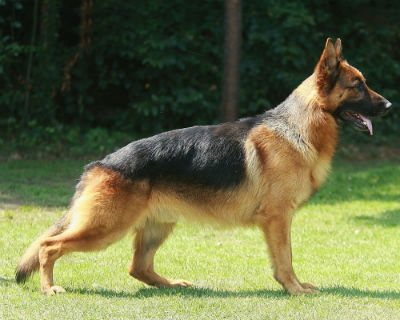
The beauty, the affable character and the intelligence These are the characteristics that led the German Shepherd to be one of the most famous dogs of all time. The head of this dog is wide and wedge-shaped. The ears on top are medium-sized, erect and pointed, making it look like a wolf. Dark eyes, in an oblique position, convey security and confidence. The powerful teeth must be strong, healthy and complete with all 42 teeth to guarantee the power of this dog's scissor bite.
You may be interested in: The Belgian Shepherd
The body of the German Shepherd is longer than it is tall, the top line is slanted downwards, so the withers are higher than the rump. The chest, slightly wide, has a depth that ranges between 45 and 48% of the height at the withers and the sternum is long and well noticeable.
The tail It is long and reaches the hook when at rest, but should not exceed the middle of the metatarsus. When at rest, the German Shepherd has its tail hanging down, while it keeps it elevated when active, even if it never rises above the horizontal line. The fur It has been the subject of controversy because there are three varieties. However, the official breed standard provides for breeding of the longhaired and shorthaired variety, both with undercoats. In the case of short hair, it is thick and adherent to the body and can be thicker and longer on the neck. For the long hair variant, it is thick but unlike the other variant, it is not grippy. However, the hair is expected to be longer and thicker on the neck than in the short-haired variant. The breed standard Supports multiple colors, including solid black, black with reddish undertones, and various shades of gray. The nose must be black. The height at the withers varies from 60 to 65 centimeters for males and from 55 to 60 centimeters for females. The weight of the males ranges between 30 and 40 kilos, while that of females ranges between 22 and 32 kilos.
Different lines of the German Shepherd dog
The breed versatility It allows different lines to exist oriented to different tasks, functions and purposes. Lines that have their own features, origins and history. Let's see what these lines of German sheepdogs are.
West German Demo Line: This is the original standard Max Von Stephanitz and the most uniform, recognizable and popular type.
American and Canadian demo line: With a firm structure and lateral gait, this line is characteristic of the demonstrations of the national German Shepherd clubs of North America since the 1970s.
West German line of work: Also considered the original type created by Max Von Stephanitz, these shepherds excel in guard work, rescue, herding, and as an excellent family pet. All this is thanks to an effort to correct the capacity, impulses and work structure.
East German Work Line: Bred under the East German government after World War II, this line is characterized by rigid control of blood lees. They are dogs known for their temperament, soundness and excellent genetics.
Czech line of work: Developed mainly for military and police work since communist Czechoslovakia, they are dogs very oriented toward defense and guarding.
Character and personality of the German Shepherd dog
The character and personality of the German Shepherd He is stable, confident and proud. The courage of these dogs is known to everyone, as well as their defense instinct. Given this natural instinct, they are among the most sought after dogs for defense and protection. However, it should be noted that courage and defense are not synonymous with aggression and danger. The German Shepherd tends not to trust strangers, even if there are no imminent dangers, and above all, it never attacks without reason. Obviously, correct socialization when he is a puppy is essential to avoid problems in the future, because character does not depend only on genes. It is an easy breed to train with positive reinforcement, like many other dog breeds.
Thanks to its great capacity for adaptation, this breed has been successfully used in various activities. The German Shepherd excels in dog sports, as a search and rescue dog, as a guide dog, police dog or in pet therapy. And of course, he is exceptional as a companion dog. The puppy that will be part of the family must be educated with affection, but also firmly. These simple precautions are the best guarantee for a relationship of affection and friendship with an animal that asks nothing more than to put its notable qualities at the service of its owner. However, you must remember that he can be sweet and affectionate with children, but he is not always able to measure their strength. For this reason, it may not be the ideal playmate for the little ones in the house. To be truly happy, the German Shepherd needs the presence and affection of its owner. Although he looks like a pet, his working dog instinct makes him generally proactive. It will therefore be necessary to ensure that you always feel useful. You should not hesitate to spend several hours a day proposing physical activities that allow you to progress and fully realize yourself.
Pregnancy and puppies of the German Shepherd dog
The pregnancy of a German Shepherd dog is approximately 2 months and 7 days, that is, 67 days. During this time, constant care from a veterinarian is essential. It is advisable, especially at birth, to have the veterinarian at your side, to be able to help in case of complications. The number of puppies may vary between 4 and 10 puppies per litter. If the shepherd bitch becomes a mother for the first time, one can count on a smaller number of puppies.
Two weeks before birth, the dog gets used to the whelping area. This should be well designed with blankets and soft paper, since the dog loses a lot of blood and amniotic fluid during childbirth. Starting one week before the scheduled date, the female's body temperature is measured daily. Approximately 24 hours before birth, the temperature drops to 2 degrees. The birth of a puppy consists of three phases; During the opening phase, strong contractions occur as the birth canal opens. In the abortion phase, the pup is expelled. This is followed by the placenta which the dog herself eats. It contains many nutrients and is released to the puppy through breast milk. Now comes the third and final phase of this wonder of nature. Since the puppy comes out in a small amniotic sac at birth, it is bitten by the bitch, and the pup is detached from the umbilical cord. The amniotic sac also eats it. These three phases are repeated every time a puppy is born. The time interval between the birth of 2 puppies can be from 15 minutes to 2 hours. Puppies come into the world blind and deaf. Only his sense of smell develops to find his mother's breasts. For the next 2 weeks his routine consists only of eating and sleeping. After this time, their eyes open and their sense of hearing develops. After approximately 3 weeks They get their baby teeth and become more active. A month after their birth, they begin to explore the area and learn to interact with other pets, such as cats. From the second month the socialization phase begins. Here, puppies learn the basics of coexistence. During this time, it is important to familiarize puppies with all the things and sounds of everyday life. From the eighth to the twelfth week it is gradually withdrawn from breast milk. As the puppies are able to take solid foods and are no longer dependent on the mother, it is the ideal time to separate mother and puppies.
The new owner must ensure that the dogs have been vaccinated or dewormed. There must also be a veterinary certificate of health status. One of the most well-known typical breed diseases in German Shepherd dogs is hip dysplasia. It is a hereditary disease that leads to serious disorders of the hip joint and the posterior musculoskeletal system of the dog. When choosing the puppy, pay attention to whether it has a healthy self-esteem, is curious and shows good alertness. Additionally, puppies should have a healthy distrust of anything new. Anxious animals are not suitable for use as a service dog. Female dogs are generally quieter and more reserved. At the age of approximately 3 months, the puppies move to their new home. From here you start with the education and training of the dog. Contact with other dogs is very important to learn social behavior.
How to feed a German Shepherd dog
Adequate nutrition from the first months of life is crucial to ensure that your German Shepherd develops good health. When you acquire a puppy, it must eat alone and be completely weaned. The age of the puppy should never be less than 3 months.
You may be interested in reading: How to feed a puppy: tips and tricks
The first tip is to ask the breeder what food they used for weaning and possibly give us a sample, in order to provide our dog with a familiar food to avoid problems with the change. Especially during the growth phase it is important to provide a nutritious, adequate and well-balanced diet. The German Shepherd, like all dogs, is primarily carnivorous. Some foods that are necessary for us can harm you or, in the best of cases, do not create any type of nutritional principle. For this reason it is advisable to choose a good feed like the one in the entire range. Blue Wolf, suitable for human consumption and based on top quality raw materials for 100% natural nutrition. The German Shepherd is a dog that, like many medium and large dogs, can be subject to certain diseases. With good nutrition you can reduce the risk of suffering from them and ensure optimal health for your pet.
German Shepherd Dog Care
The German Shepherd can get used to living in an apartment, but in this case he will need a lot of walks and exercise to strengthen his muscles. Having a garden helps, but it doesn't have to completely replace walks and play sessions outside the home. Allow him to practice a sport for dogs, as it helps him drain accumulated energy and stay in shape. Training is also useful in helping you develop your intelligence.
Taking care of the German Shepherd's coat is not very difficult because it is not necessary to cut it frequently. However, since he tends to shed a lot, brushing him every day is very important. You should not bathe him often to avoid damaging the natural protection of the coat.
You may be interested in: How diet influences your dog's hair
Health and diseases of the German Shepherd dog
Unfortunately, the great popularity of the breed has encouraged indiscriminate breeding for purely commercial purposes. Indiscriminate breeding has had a negative impact on the health of the breed. It is for this reason that The German Shepherd is prone to developing hereditary diseases such as hip dysplasia, elbow dysplasia, digestive problems, epilepsy, chronic eczema, keratitis (inflammation of the cornea) and dwarfism.
It is important to take the dog to the vet every 6 months and respect the vaccination schedule. The life expectancy of the German Shepherd is approximately 13 years.
Education and training of the German Shepherd dog
Since the German Shepherd is a intelligent, careful and disciplined dog, its training does not present particular difficulties. However, if you are not an expert, it is good to consult a professional. German Shepherd training should begin around 7 or 8 months. To properly train a German Shepherd, it is enough 10 lessons, during which, always accompanied by its owner, but under the orders of the trainer, the dog will learn the essential notions that will make it an educated companion. Behavior on a leash, foot calling, the habit of responding to one's own name and traditional, but no less necessary, commands.
When the dog has correctly assimilated these first routines, the trainer will continue the perfecting process. First of all on the track, where the German Shepherd learns to jump, bark at a stranger, etc. Then in the field and in the forest (we must not forget that if the Belgian Shepherd is considered the sprinter on the track, the German Shepherd is more powerful in open spaces). Finally, you work in an urban area, where you will have to get used to the noise of cars, the coming and going of people, etc. In short, it will be inserted in all the environments in which it will have to develop and adapt. Then the defense exercises can begin where the trainer will instruct the dog to guard a house, a farm, defend children, etc.
[embed]https://www.youtube.com/watch?v=2MSyy3OURdo[/embed]
All the trainers agree on the same message, all training must be understood as a pleasure for the animal, otherwise the result may be opposite to the desired one. In 10 hours, the young German Shepherd will transform into a balanced and effective defense dog. In fact, a guard dog should never be an aggressive dog. Contrary to popular belief, aggression is not part of the nature of this breed. The trainers' mission is to teach you to deter any malicious person, not to attack them. Only after all this can the competition begin and take on its main tasks, from a long list of roles that it supports with great success (army, police, customs, disabled people, mountain and disaster rescue, etc.).
Conclusion and tips for acquiring a German Shepherd dog
Always try to look for a serious and professional breeder, in order to guarantee healthy puppies with a health record and first vaccinations. You should also request a guarantee of a few months, in case the puppy develops hereditary health problems. Logically, the puppy will have to be at least 3 months old to be able to take it home.
It is also preferable to be shown the parents, so you can get an idea of what they will be like as an adult. When it comes to choosing the right puppy from a litter, you need to choose wisely. However, choosing the right puppy is never an exact science and requires a little attention, so as not to risk the breeder making a totally random or self-serving decision. Most people tend to base their choice simply on the physical appearance of the puppy, rather than taking the time to get to know its individual characteristics. This can lead a person to make the wrong decision.
Videos about the German Shepherd
[embed]https://www.youtube.com/watch?v=R3FvEjqekqU[/embed]
Other sheepdogs:
Bobtail or English Shepherd
Belgian Shepherd
Basque Shepherd
Catalan Shepherd
Garifan Shepherd
Australian Shepherd
Bergamasco Shepherd
Persian Shepherd
Our Blog
Border Collie | history, characteristics, feeding and care
by Lobo Azul in Jan 12 2023
between many dog breeds There is only one that stands out for its great intelligence and this is given by the quality of response at the time of its training. This is what Dr. Stanley Coren says in his book “The intelligence of dogs”. We are talking about Border Collie or also known as Collie border in Spanish, currently considered the most intelligent dog in the world. If you already have a Border Collie as a pet, you will have been impressed by its agility, fidelity, obedience and learning capacity. Continue reading and you will know how to best care for this exceptional breed.
Size: Medium.
Weight: Between 17 and 20kg.
hair type: Long (12cm) or short (8cm) double layer hair.
Character: Strong, dominant and faithful.
Health: Good health
Life expectancy: Between 12 and 15 years.
Origin and history of the Border Collie
The Border Collie is a fairly old dog. Its first appearance was made in Europe specifically on the border between Scotland and England. It was introduced by the Gallic tribes we know as Celts between the 5th and 1st centuries BC. Although originally it was used as herding dog, today it is one of the most notable breeds in sports and dog show competitions, almost always achieving unsurpassed results.
Historical records dating back to 1570 attest to the Border Collie's sheep herding activities in the regions of the United Kingdom. It was a dog that could lead the flock regardless of the presence of the master or the weather conditions, with efficiency and firm personality. By 1860 this breed began to become more popular after it was known that they were Queen Victoria's favorite pets and a portrait of one of his dogs that is very similar to the current Border Collie was exhibited on this date.
The name collie It has several connotations. Some researchers claim that it is a word of Celtic origin that means "useful." Others believe that it comes from the word coley meaning “black” or from the Welsh word coelius, which expresses “faithful.” There are also those who claim that the word comes from the word colley making mention of a type of Scottish sheep. In regards to “Border” is much clearer because it reminds us of the place where this breed appeared or its first ancestors to set foot on European lands, which is on the border between Scotland and England. Its translation into the Spanish language is border collie.
Physical characteristics of the Border Collie dog
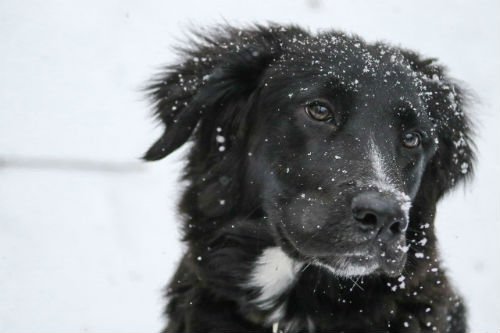
The Border Collie He is an athletic dog and in very good shape.. It is very well proportioned. It has a lot of energy and must always be in motion. It is advisable for its upbringing to keep it in open outdoor spaces where it can carry out its exercise routines. It is an animal that enjoys very good health. There are two specimens of this breed: the short-haired and the long-haired.
These are its physical characteristics:
Size. The Border Collie is a medium-sized dog. Its height is usually between 45 and 55 cm. Males are a little taller than females, measuring 50 to 55 cm and females between 46 and 52 cm.
Weight. As it is a medium-sized dog, the appropriate weight does not exceed 20 kilos. Males weigh between 17 and 20 kg. and females between 15 and 18 kilos.
Head. The Border Collie is a dog with a wide and powerful head. His cheeks are thin.
Snout and nose. Its snout is elongated and pointed, short and very strong. The nose is generally black with well-developed orifices. Depending on the coat, the nose can be brown.
Jaw. Strong teeth and jaws. Its bite is scissor-shaped.
Ears. Medium sized and separated. Some specimens of this breed have them upright, semi-drooping or completely fallen. Your auditory system is very sensitive to external noises.
Eyes. Oval, medium and separated. His look is very expressive and sweet. They always show joy or attention to any movement. The predominant color is brown, but there are usually specimens that have blue or two colors (blue-brown) with each eye being a different color.
Neck. Strong, of medium length and muscular that widens in the part that joins towards the back.
Body. Rectangular in shape and very well proportioned. Longer than tall. It is a very slim and athletic dog.
Extremities. Its limbs are strong and muscular. Its legs are strong and oval in shape.
Line. It is long, low and curved upwards at the tip.
Fur. There are two types: long hair (12 cm) and short hair (8 cm). In both cases this breed has a double coat. The color varies between black, brown, black with white, tricolor, blue merle and blue merle tricolor. This breed also includes specimens in shades of brown tricolor, red merle, red merle tricolor, seal, seal merle, sable, sable merle, lilac and lilac merle.
Life expectancy. The Border Collie is a dog that enjoys very good health as long as we give it the proper care. If this is the case, it can live between 12 and 15 years.
Intelligence, character and personality of the Border Collie
There are three things that stand out in this breed of dog and they are: his intelligence, character and personality.
Intelligence
It has an innate intelligence that makes it stand out above any other race. If in any breed of dog its ability to learn the rules of obedience is achieved after 30 or 40 repetitions, in the Border Collie its learning is achieved after 5 repetitions and it must be taught new rules of obedience, since it is a dog that if it falls into monotony immediately shows a lack of interest in continuing doing the same routine that it has already learned. That is why His learning ability is exceptional. and surprising things can be achieved, as long as your coach is willing to enrich that learning.
Character and personality
The Border Collie is a dominant breed, with a strong personality. It is made to lead flocks with all the security and firmness as if its own owner did so. As a companion in the home, he is a faithful ally and great guardian. He is always attentive to the slightest noise or movement and will take care of family members in complete safety. He is a very energetic dog and likes to always be on the move so if you decide have a Border Collie in your family You should know that this breed needs to be taken out for walks and recreational activities at least three or four times a day. If you use the Border Collie as a task or work dog, it will never let you down because it loves to feel useful.
Another important thing that stands out about this breed is its look. It is a very observant and intuitive dog so, if you are happy or sad for any reason, your companion will be the first to sense it since It is a very sentimental breed that creates a very strong bond with its master.. He has a very close relationship with children. In short, he is a very disciplined dog.
Border Collie puppies
Border Collie puppies are very active and restless puppies. Like any puppy, it must be kept with its mother until weaning, which begins with the appearance of the first teeth. The food to be replaced should be rich in calcium and protein, ideal for medium-sized dogs in the growth stage. Remember that you should not overfeed your puppy so daily portions of 120 grams divided into three batches is more than enough.
Regarding their training, this should begin from 6 weeks after being born. Start with simple rules like throwing him a ball and having him bring it to you, calling him to come to you, and using positive reinforcement to motivate him for his good actions. When it comes to care, remember to take it for a strict medical check-up since the veterinarian will know how to tell you the vaccination times and will know how to tell us if our pet is growing healthily and happily.
In our blog you can learn more about how to train a puppy.
Border Collie nutrition and health
If there is a weak point in the Border Collie it is its stomach, so you must be very careful with it. food you select for this breed of dog. It is not that this breed is complicated to eat, but because it has a delicate stomach we must try carefully until we find the right type of food.
Food
The food we select must be ideal for medium breeds. When he is a puppy, he chooses foods rich in calcium, protein and rice-based cereals. You can combine a dry food with a wet one, but you should do it little by little and with a lot of observation for any reaction that may occur. When your Border Collie begins the adult stage (this is achieved after one year), select foods and quality feed with a high protein content since This breed likes to always be on the move. and its energy consumption is high. Food portions at this stage should not exceed 450 grams per day.
Already entering the last stage of life and when you begin to age You must prevent this animal from reaching this moment in life overweight. and that will depend on the diet you have given it throughout its life. In any case, consult with the veterinarian who will know the type of food and the proportions he needs, although it is advisable to reduce the dose a little since his life is not as active as when he was a puppy or a young adult.
Health
The Border Collie is a breed that is generally in good health. They are very active dogs whose intelligence also helps them maintain a healthy mind. Likewise, it is very important that you pay close attention to your visits to the veterinarian. Twice every six months would be more than enough to establish the vaccination schedule and general check-up unless a condition appears and we have to go to the doctor.
In any case, some hereditary diseases that can occur in this breed are:
hip dysplasia
It is caused by a femur and hip problem. This causes a lot of pain and limits the animal's movements. To prevent its appearance, it is important that the animal receives the necessary type of food in addition to the appropriate portions according to its age and is not exposed to excessive physical training. That is why you must be aware of the relationship between food and adequate physical activity so that this hereditary disease does not appear.
Osteochondritis dissecans
This disorder affects the joints. The Border Collie is a very active animal and always makes unexpected movements or turns. In one of these sudden movements it can happen that the bone found under the cartilage in the joints dies due to no blood flow. If you notice that your animal begins to limp after a few days and this does not improve, then you should go to the veterinarian to take an x-ray and apply the appropriate treatment.
Epilepsy
This disease has a high genetic load. The epileptic attacks that may occur in your dog can appear due to socio-environmental problems such as an explosion, explosion, storms or also caused by poisoning or further such as brain damage. If this case occurs in your Border Collie, the treatment it receives will be for life. This breed, unlike others, has a longer life expectancy.
Eye problems
Border Collies sometimes have vision problems. One of the problems that can appear and is hereditary has to do with a congenital deformation in the eye membranes due to an anomaly in their development. This can lead to partial or complete loss of vision. The appearance of cataract is also another of the diseases that can appear, although it is treatable and curable, you must be attentive; So when you take it to your veterinary visit, ask for an eye check to be sure that your pet is not suffering from any of these diseases.
Parasites
Because Border Collies are highly physically active animals and are always exposed to fields, gardens, parks and other types of places where other types of animals and other breeds of dogs live, They are very prone to having some types of parasites such as ticks or fleas. Because it is a very hairy dog and that is something that these types of parasites love, we recommend that you do almost daily and very thorough checks every time you brush it. We suggest that you use some of the products that your veterinarian can recommend such as pipettes, powders or antiparasite collars. Dogs of this breed that live outside of cities such as in the fields where they have contact with other types of animals, must be fitted with a pipette or collar to avoid mosquito bites that cause Leishmaniasis.
Border Collie Care
Border Collies have a rather delicate digestive system and do not always react well to changes in food brands. It is important that you try little by little until you find the right feed. If you notice that your dog is vomiting then it is a sign that the food is not doing him any good. If you change the brand or flavor, we recommend that you introduce it little by little until you find the right food and the animal feels comfortable and satisfied. A tip: Try hypoallergenic pet foods (gluten free).
Another care that we must be very aware of is brushing. Border Collies are dogs that have a double coat of hair and it is very common for them to harbor many parasites. Border Collies with long, thick hair (because there is another type that has finer and softer hair) usually have a lot of knots in their hair, so a couple of brushings a week and a thorough check-up would be more than fine. Within the care you should not forget the moment of the bath. These dogs have a very elegant appearance and its coat, if well cared for, makes it look very distinguished. It is recommended that we bathe him every four or six weeks. Use special products for long-haired dogs. When we bathe him, avoid scrubbing him with circular movements, rather use your fingertips to massage his skin and undo any knots that may have formed.
The Border Collie It is a very intuitive and sentimental animal.. He likes to be in company and is able to perceive any mood we are going through. They do not like to be alone and it is not recommended that they remain alone for a long time because they easily become stressed and distressed by not perceiving the presence of their owners. We recommend that you give him a lot of love and affection. Reward him when he does his job well with positive encouragement, a squeeze or caress, or one of the pet treats on the market. Talk to him and he will know how to respond with gestures to some words that he can get used to recognizing.
Education and training of the Border Collie
education and training a Border Collie It must be done both physically and mentally. The first thing you should know is that This dog breed requires high physical activity. Generally people who are very active and who practice sports such as jogging or cycling or who practice hiking Border Collies would be the ideal pet to be in company and take them with them. It requires daily walks, which do not exceed two hours in its routine, always divided into 40-minute sessions. Take him to a park and let him run and interact with other dog breeds, and it is also good for him to get used to being among people to improve what we call his socialization process.
If you are a very sedentary person and you do not like to go out for a walk or walk, then it is better to forget about having a Border Collie, because otherwise this animal will become a torment that will not stop barking and destroying everything in its path. If you want to know the reasons why a dog howls, visit our article: Why do dogs howl? In short, you will have a nervous and crazy pet that will destroy the entire house, and this is a consequence of lack of attention. Another thing that you can practice and that Border Collies love it It is to take him to parks or training places where there are circuits with jumping bars, tunnels where he can jump, crouch and do all kinds of acrobatics. Dogs of this breed always stand out in sports competitions and agility.
On the other hand, do not forget that we are talking about smartest dog in the world. You have to stimulate their mind and memory. To do this, we recommend that you play memory games with him, such as hiding something and having him look for it and bring it to you, or maybe play hide and seek. Also games with images give surprising results. Use specific words that your Border Collie can recognize such as “come here”, “sit”, “go”, “run” in short, keys that he can recognize at the first call of your voice. These dogs are very intelligent and you will be impressed with what they can learn in 4 or 5 lessons. There are also many interactive toys on the market that can help stimulate their intelligence.
Lastly, don't forget that this breed learns very quickly So don't fall into countless repetitions or always teaching him more of the same. Always offer him new training and things to learn, to take on new challenges with greater degrees of difficulty and complexity and you will see your pet grow and develop in a joyful, healthy and happy way. Discover other dog breeds on our blog:
Bernese Mountain Dog
Tibet Doge
bull terrier
American Bulldog
Labradoodle
Dingo
Boxer
english bulldog
golden retriever