
Our Blog
Our Blog
10 basic commands that every dog should learn
by Lobo Azul in May 11 2023
The training It is one of the most important issues in the presence of a new pet. The arrival of a puppy into the family requires a series of changes, in which the responsibility for its education is one of the basic aspects that every owner must consider as a priority. The education of the canine constitutes a fundamental basis to form the behavior and temperament of the animal from an early age. ButWhere do I start training my dog??
This question is very common, even more so when it is the first time that one takes responsibility for a pet. It is for this reason that on this occasion we will describe ten basic orders that should not be missing from the moment the dog's training begins. The commands that we will indicate below are essential in the educational training of the dog. They are the first step for the dog to learn other tasks, and above all, they will be part of its daily behavior at home and outside. Therefore, learning is essential.
Sitting
Without a doubt, the first and, if you like, easiest command that can be taught to a dog is to sit. This is the first of the instructions that every owner, whether expert or not, must carry out with their canine. Not only because it is the simplest, but also because through it the dog can communicate different situations such as, for example, asking for food or going outside.
How to teach it?
One of the most effective ways to teach this command is to show the dog a treat or reward and let him sniff it for a while. Then, enclose the treat in your hand and, with your fist, draw an imaginary line from the head to the back of the dog, while you indicate the word «sitting» or «sit«, as you prefer. After several attempts you will notice that the dog sits when you perform this action. A key aspect is that you must maintain a permanent command for this order, once you have started. For example, if your word is "sitting", you should continue training with this word. The dog will register this word in his mind to relate it to this command.
[embed]https://www.youtube.com/watch?v=Pj04ZSOv_ug[/embed]
still
So simple that it may seem boring and unnecessary, but it is really one of the most useful and meaningful learning commands for the dog. Learn to be «still«, whether when there are visitors at home or during breaks during walks in the park, this is a basic order that cannot be missing in initial training.
How to teach it?
It's very simple, once the dog has learned to sit, ask him to do it. And with a signal that is of your preference (usually it is showing the palm of the hand) tells the dog not to move and take two steps back. If he does, while you move, come back and reward him with a treat. In this way, after constant training, increasing the distance when you move away, the dog will adapt to this command and will do it with great ease when you ask it to.
lying down
Both lying down and «lie down» in conjunction with sit and stay, are not only basic commands, but consecutive ones. Therefore, this is the third of these basic indications that cannot be missed. Especially if what we want is for the dog to stay by our side, resting.
How to teach it?
Tell your dog the sit command. Once there, and again with the treat in your closed hand, slowly move it towards the ground, indicating to the dog that it should lie down, following the course of your fist. Like the previous ones, after several attempts the dog will understand and relate both the word and the movement to this command, and it will do so automatically when you tell it to.
Come
So to speak, calling the dog to come to us is one of the most important commands, despite not being the first one they learn. what the dog answers our call When you run out and come back, it is one of the basic and necessary aspects that must be practiced with the dog.
How to teach it?
The popular «come here«, or simply «come«, requires a little more practice than the previous orders. However, it is not a complex process. In principle, you should place the reward on your hands or feet, without the dog noticing. Once this is done, call him with the command you want to use, remembering that this must be permanent once the training begins to make it easier for the dog to relate it. When he approaches, offer him the reward you saved and a word of motivation. At first he may not understand, but later he will associate that when you call him, there will be a reward for him and he will answer your call. Try the same exercise keeping a greater and greater distance, this way it can be useful even if you are several meters away.
[embed]https://www.youtube.com/watch?v=3KQ4KLCymcA[/embed]
Walk with your owner
As you learn the basic commands, the level of complexity also increases. That is to say, greater perseverance and patience are required for training, especially when we teach him to walk alongside us. A process with a greater degree of difficulty, because it is normal, on a walk, for the dog to pull on the leash to stop to sniff or observe something. That is why the importance of this order is essential.
How to teach it?
The usual thing is that during the walk, when the dog begins to pull on the leash, you give him the command to sit. Once done, tell him to stay still and try to resume walking. If it doesn't stay still, try again. And this time, as he resumes the walk, he indicates to the dog with a "let's go» or «forward«, who must walk next to you. If he tries to walk away again, using the word "together» Practice ordering him to go to your side. If he doesn't obey you, tell him "Nope!» And tell him the order again, so he knows what you mean. An important aspect is to always select the same side to walk in this way, the dog will progressively understand the walking pattern next to you.
[embed]https://www.youtube.com/watch?v=YH2LnERyMSU[/embed]
Bring
This is a command that will not only keep our dog entertained and release tension, but will also teach him to deliver objects that we have thrown or hidden around the house. Teach your dog to «bring» something is, without a doubt, healthy and useful.
How to teach it?
The first thing is to allow the dog to identify with the object, for example, a ball. And then launch it, indicating with the command «brings» that he must return to her. Once you bring it to us, it is important to reward it and continue, since it is normal that in the first attempts it entertains itself with another object. The orderssearch» and «loose«, go in conjunction with this indication, because the dog is stimulated and also taught to look for the object and return it.
[embed]https://www.youtube.com/watch?v=PYM0a1f-7Rc[/embed]
Search
This command, like the previous one, stimulates the dog's exploratory sense, its sense of smell and its mind. It is a progressive learning because to bring the object that we have launched, the dog must search, until it is found and returned to the hands of its owner. Once the dog has returned the object, it must be rewarded for the successful exploitation. The first attempts will probably not be so easy, but later you will feel more comfortable and, above all, entertained.
let go
In addition to fetch and fetch, teach the dog to let go of the object It is a very necessary order, since it is common to see how they cling to anything, like a ball, and do not want to return it. Properly teaching him that he must return the object voluntarily, without having to remove it from his mouth, will help us have a calmer and more balanced pet.
How to teach it?
In these cases, once you have found the object and brought it back, it is appropriate to show our hand, indicating the command «loose» so that it notices that we are asking to return the object. Once you have done it, it is important to reward your action, this way you will do it more easily.
Go
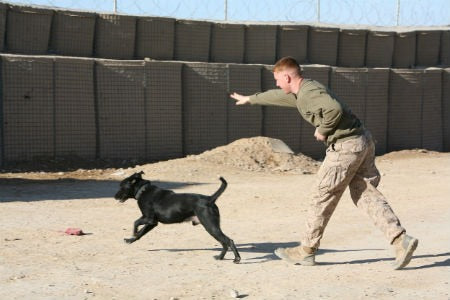
Also known as «forward«, this command is usual to tell the dog to run or move freely, or also to stop the work it was doing. Although, in most cases, it is more common in the first aspect. It is very easy for the canine to adapt, because it is like a green light to allow it to run or move without any inconvenience. To practice this order, it is important to first educate him to respond to the call and be still, so that if we notice him moving away, we can be sure that he will respond to our indication to return.
Jump
Although it is the last on this list, it is no less important. A very useful order in dog training, and carrying out exercise routines, is “jump”. This indication is more common when dogs practice sports such as Agility. However, it is appropriate to help them overcome walls or fences. When practicing games and training, this order is very useful and can even be fun to learn.
[embed]https://www.youtube.com/watch?v=m1j3wjIdS40[/embed]
Conclusion
Without a doubt, dog training is full of endless important aspects to achieve the mental and physical balance of our dog. Training is a deep and interesting topic that must be constantly practiced from an early age of the canine and as it develops. An aspect that must not be forgotten under any circumstances is the positive reinforcement. Education based on the reward and motivation of this technique will allow the results to be more noticeable and faster, instead of wrongly adopting an authoritarian and aggressive behavior towards the pet that will not produce good results. It is important to emphasize the practice of the positive reinforcement method in training, with the certainty of visualizing an adequate education, where in addition to learning, bonds of trust and comfort will be established between the dog and its owner or trainer. More about dogs:
How to train a puppy
Train dogs anxious about food
Is your dog afraid of other dogs? Causes and solutionnis
Our Blog
What can I do to stop my dog from asking for food at the table?
by Lobo Azul in Jan 17 2022
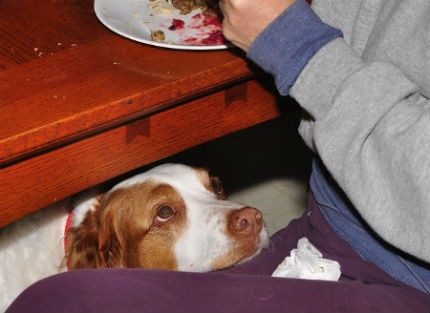
A situation that is common in families with pets is that at mealtime, the dog is hanging around the table, with a sad face, waiting to be given a bite of food. This fact, in some cases, can be funny due to the endearing and constant look that your dog shows to achieve his goal of getting a little bit of your plate. However, repetitively it becomes a bad habit. And let's remember that feeding a dog human food is very harmful to its health. When it becomes frequent, this bad habit notably reflects inappropriate behavior on the part of your dog, and the lack of appropriate training to reduce this type of behavior. But, it is never too late to correct this type of situation. There are effective and very favorable solutions that can help eliminate this habit from your pet's behavior. Do you want to know what to do so your dog doesn't ask for food at the table? Read this complete article and you will find the easiest solution to this situation.
Understand this behavior
Before taking any action to eliminate your dog's habit of asking for food at the table, it is important that you understand that it is an innate habit in him. Although it is true that, When it becomes frequent it is due to lack of training, dogs by nature are animals with frequent need for food, a behavior inherited from their descendants, the wolves.
The latter, accustomed to hunting smaller prey in order to feed themselves, took advantage of every opportunity to eat, because it was sometimes difficult to provide food. From there, dogs inherited a kind of instinct that always makes them want to eat. For this reason, although it is an unpleasant habit, especially in the presence of guests, it is natural for dogs to approach the table with a languid look, waiting for a bite. However, despite being a behavior of canine nature, there are different techniques that can be applied to remedy this situation and stop your dog from asking for food at the table.
What should I do?
It is very important to understand canine behavior before carrying out this action, since understanding the reason for this behavior will allow you to take the appropriate measures to prevent it from becoming an unpleasant habit that your pet adopts. In the following paragraphs you will find different techniques that will help you prevent your dog from asking for food at the table in a progressive, but also very effective way, without having to resort to mistreatment or erroneous actions. Where to start to eliminate this habit? Let's see:
Ignore the canine while eating
One of the main reasons why dogs have the recurring habit of asking for food at the table is that, by doing it insistently, someone succumbs to their request and ends up giving them some food. Therefore, the first method to eradicate the problem It would be ignoring your request. The moment we are at the table, it will be necessary to pretend that the dog is not there. In this way, when he realizes that they are not paying attention to him, he will withdraw and will not insist on it anymore.
Establish a meal order
One way to prevent your dog from staying near the table when you are eating is to feed him before sitting down to eat, or preferably at the same time. In this way, the canine will stay busy and satisfied and will not go near the table at least for a while. If fed twice a day, schedule a time that coincides with family meal times It will be appropriate to prevent him from hanging around the dining room.
Take it off the table
If the dog gets too close to the table, the ideal is to remove it calmly and gently, indicating that it should not be there. Decidedly, although not using screams, say No! And make it clear to him that this is not his place or his food.
Show him his food
Another way to reduce this situation is to show him his food bowl every time he insists on eating your food. This will convince him to feed from his feeder, and not be near the table.
Persevere in the lessons
A really important aspect to reduce this behavior in your dog is stay firm and persevere in telling him that he should not remain at the table and that you will not share your food. If one day you give in to his request, you will have gone backwards in his training and the dog will feel that it is not a bad habit.
Make family consensus
If your dog tends to ask for food at the table, it is necessary that none of the diners feed him. That is why there must be a family consensus so that no family member provides food at meal time. Otherwise the habit will not disappear.
Reward him when he obeys
Teaching your dog not to ask for food at the table is an educational process like any other in which you teach him orders and tricks. For this reason, it must be carried out progressively, patiently and above all constantly, remembering the use of positive reinforcement. If you say No! and the dog stops insisting, recognizes its obedience with a reward, this will work in such a way that some time later the dog will not get closer to the table and a treat will not be necessary as a reward, but it will become part of its good habits.
To conclude
An aspect that is important to consider is the persistence, both of the family group and of the guests of the house, to not encourage this bad behavior in the canine, feeding it while at the table. Another effective way is to teach him to stay in his resting place, which can be located a few meters from the table, comfortably, without having to be among the diners to order food. In any case, the most important thing is perseverance in an education process that, if carried out correctly, will provide favorable results and your dog will stop asking for food at the table forever. We recommend:
Agility: Sport and fun for dogs.
How to train a puppy
6 tips to walk your dog correctly
10 basic commands that every dog should learn