

Our pets are an important part of the family and that is why we always try to ensure their well-being. We take care of their diet, hygiene, illnesses and, in general, all aspects that allow them to maintain a healthy life. To contribute to the care you give to your pet, today we will talk about gastric torsion in dogs: its causes, its symptoms and some recommendations, since it is a disease that can be life-threatening if not treated immediately. It is always important to offer a good diet, in this case it is advisable to use feed with a lot of digestibility from the Super Premium range. As it is more digestible, the daily ration will be lower and the dog will be better fed. In breeds that are very prone to or have this pathology, it is recommended to give them the daily ration divided into two doses. In Lobo Azul feed, we have Super Premium Lamb Feed available, which gives very good results in dogs with delicate stomachs.
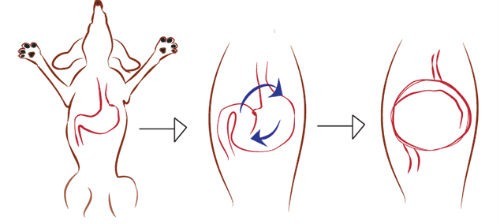
 Gastric torsion in dogs is caused by the accumulation of gases in the stomach and the inability of the body's own physiological mechanisms to empty them. This accumulation causes the dilation of the stomach walls and their rotation or twisting on its longitudinal axis, causing in turn strangulation of the veins and arteries that supply it, hypovolemic shock – or reduction in the amount of blood circulating through the body – and severe ischemia – or decreased blood flow – of the walls of the stomach. Sometimes, More or less pronounced torsion of the spleen may also occur. by the pressure exerted by the stomach and also twisting or intestinal strangulation, what is known as volvulus. The entire picture of difficulty in blood flow, plus the accumulation of substances that mediate inflammation, causes cardiac arrhythmias and severe poisoning in the dog. In addition to the inability to empty the stomach due to the torsion it suffers.
Other dog conditions that may interest you:
What is gastric torsion?
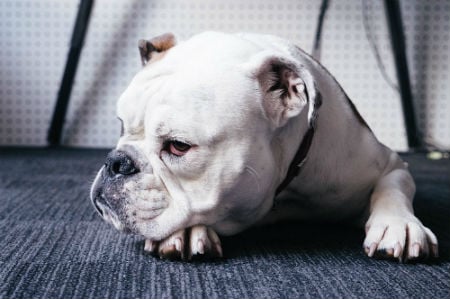
Gastric torsion, whose full name is gastric dilation-torsion syndrome, is an acute disease that occurs in many groups of animals, including man. In dogs, Breeds more prone to gastric torsion They are the big ones, with deep chest, type boxer, great dane, german shepherd,giant schnauzer, doberman, bulldog, dalmatian, among others, although smaller breeds can also suffer from it if they are not provided with adequate nutrition.
What happens during gastric torsion in dogs?
Causes of gastric torsion in dogs: some hypotheses
It is not known exactly the causes that cause gastric torsion in dogs. One of the proposed hypotheses is the inability of the ligaments that support the stomach to adequately support it due to the great dilation it suffers from the accumulation of gases. However, it is also believed that It may be related to some abnormality in stomach movements and even that it has some hereditary component. Its appearance has been associated with copious food intake in one sitting, as well as eating very quickly, drinking a large amount of water, and eating immediately before or after performing physical exercise. The development of stressful situations for the dog during mealtime has also been mentioned.Symptoms of gastric torsion in dogs
Initial symptoms
The first symptom that may appear is inflammation or swelling of the stomach, which should attract your attention and be a reason for careful observation of the dog, as it can progress rapidly until gastric torsion occurs. Given these first symptoms, it is important to take appropriate precautions, which may include a visit to the veterinarian, since early detection will allow for adequate and timely treatment that can save your dog's life.
Associated symptoms
In addition to inflammation or swelling, your dog can begin to have other symptoms associated with the internal process that is being developed:- Produces a lot of gas or belching.
- He appears restless and complains.
- suffer from abdominal spasms that make you nauseous and want to vomit, but are not able to do so; spit foamy saliva.
- The abdominal cavity sounds like a drum if you tap it gently.
- You can present difficulty breathing.
- You will see that something is happening because he will be depressed, weak and without appetite.
Treatment of gastric torsion in dogs
Initial treatment
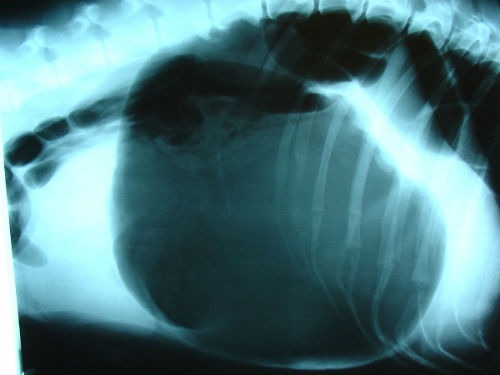
The main treatment is Immediate attention to your dog from the veterinarian who will proceed with the diagnosis, for which he can be helped with an x-ray that will allow him to see how distended the stomach is. As soon as possible, you should stabilize him by giving intravenous fluids and antibiotics and, if possible, emptying the stomach to reduce the pressure. Once stabilization of the dog's general condition is achieved and depending on the severity that the torsion has reached, surgical intervention may be necessary to return the stomach and spleen to their natural position and eliminate the parts of intestine that have suffered necrosis. Sometimes the stomach must be connected directly to the colon to avoid future episodes of torsion and must be fixed to the costal wall to avoid the risk of future torsion.Postoperative treatment
In addition to all the care that must be followed in emergency treatment and possible surgical intervention, you must be especially careful with subsequent treatment due to the risks of infection that may arise that could lead to peritonitis. However, one of the largest postoperative complications It may occur due to the resumption of blood supply to the affected tissues. When normal blood circulation is restored, cardiac arrhythmias may occur that must be treated with the indicated drugs.