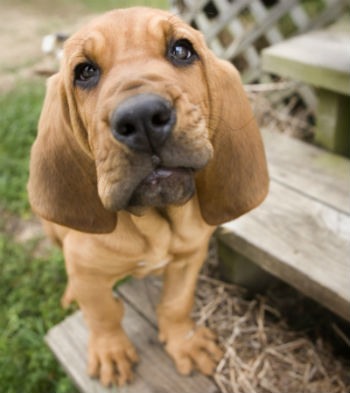
Also known as Saint Hubert dog Due to the special history that underlies its beginnings, the Bloodhound It stands out for being one of the oldest breeds in the world that has gained popularity in England and Europe for its excellent hunting skills.
Size: Big.
Weight: Between 15 and 25kg.
hair type: Short, Fine and hard.
Character: Balanced, faithful and calm
Health: Predisposition to develop some degenerative and hereditary diseases
Life expectancy: Between 10 and 12 years.
Its developed sense of smell, combined with a well-proportioned body structure, has made it become a tracking dog, frequently participating in police work. Although they have not been widely used as pets due to their size and weight, which can be intimidating, these dogs can become excellent household companions. He will establish strong bonds with his masters, in addition to offering protection and love to those he considers part of his family. Are you thinking about adopting one of these big guys? This is the opportunity to learn everything about this balanced but imposing breed. Don't forget to learn fundamental aspects such as its history, care, temperament, health and everything you need to train it properly. Join us as we review every detail of this hound's life in this article that we have prepared for you.
History of the Bloodhound
Its origin is marked by very particular events. Firstly, the breed is known to come from Belgium, specifically the Ardennes region. Although the indications are few, they have become sufficient to define that these hounds They had their origin in the Monastery of San Hubert, the name by which these dogs are also recognized.
The data shows that the founder of the order, Monk Hubert, was an amateur hunter who owned a group of robust black and tan dogs of the breed. bullmastiff, who accompanied him in the activity. It is then assumed that these were the participants in the creation of the Bloodhound. After the death and canonization of the monk Hubert, the specimens remained in Belgian territory for some years without being made known. However, in the 11th century, King William "the conqueror" imported some of these dogs to England, where knowledge about this breed began to spread. The name Bloodhound was given to it once it was located in English territory, to refer to the purity of its blood. In this country he was recognized for his tracking skills, thanks to his excellent sense of smell. This made the dog's preference for tracking tasks and sports such as hunting immediate. Currently it continues to be widely accepted in these tasks, however, it has also been recognized as a loyal and noble dog, with highly valued characteristics to be an extraordinary pet.
Characteristics of the Saint Hubert Dog
According to the International Cynological Federation (FCI) In the breed standard, the Bloodhound (or Saint Hubert dog), is one of the strongest hound type dogs in the world. This qualification is not in vain since, in addition to its enormous stature, the body build of this breed is notable. A well-formed, muscular body, slightly longer than wide, giving a rectangular, solid and noticeably strong shape. Let's get to know in detail the most outstanding physical characteristics of the breed:
Bloodhound Weight and Size
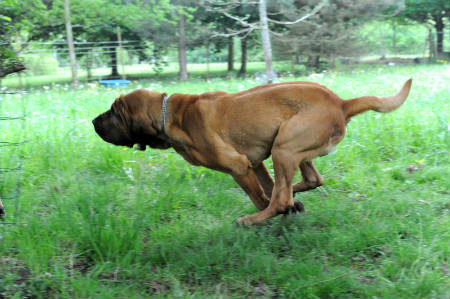
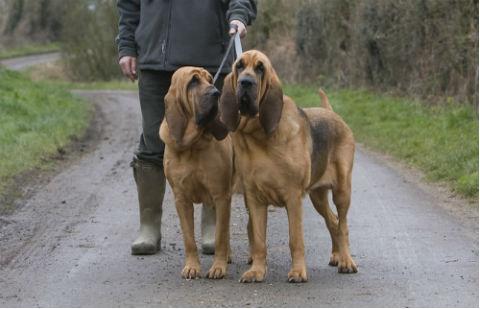
The height of these dogs varies according to their gender. In this case, the females measure from 58 to 63 centimeters, while the males range from 63 to 70 centimeters at the withers. The weight can vary according to each dog, but is generally between 40 and 50 kilos. Despite this, it does not appear as a fat or coarse animal; on the contrary, its muscular structure provides it with strength and agility in its movements, as well as speed.
head
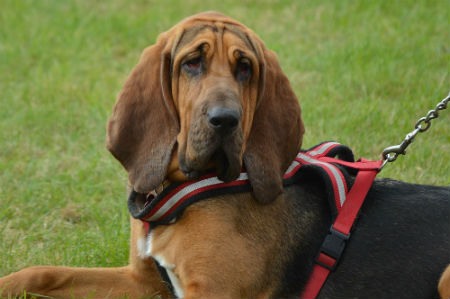
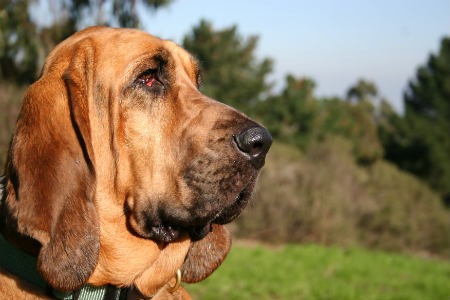
Pronounced, harmonically according to its body, it is wide and square in profile. Covered by notable folds and wrinkles, an aspect that undoubtedly defines the appearance of these dogs. A dog with elongated, thin and flexible ears, which are covered by a type of velvety fur, detected by touch. They are set low and their location makes them even more striking, as they are located almost at eye level or even lower, extending to the neck in some cases. Due to the folds on their face and distended eyelids at the bottom, the eyes of this breed can look sad and even show the conjunctiva part of them. So you have to be very careful, because visual diseases can appear easily.
Nose
His nose is large, with very wide and open nostrils, which makes him possessor of a keen sense of smell, which is one of its greatest virtues.
Extremities
This big guy's legs are straight, thick and strong. Providing great agility and dexterity when moving.
Fur
The hair of this breed is characterized by being short, straight and hard. In parts of the body such as the head and ears, it feels velvety and soft to the touch. While in areas like its tail it may be longer and a little rough. The colors accepted for these dogs are red or combinations of black and tan or tan and liver. In some specimens it is common to find white spots in the area of the legs, tail and chest.
Bloodhound Temperament
Contrary to what many think due to its intimidating build, the Bloodhound's character is very pleasant. This is a dog with an affectionate, loyal and slightly introverted personality. They are dogs that, although self-confident, turn out to be very shy. Although yes, we are talking about an excellent protector, he will not hesitate to protect his loved ones and show his strength if necessary. Although some do not consider it a suitable option as a pet, having this breed at home can be quite positive.
As in most cases, everything will depend on the socialization that the dog receives. However, these dogs are patient by nature, that is, in homes where there are children, these dogs adapt very easily to being friendly and fun with them. In the presence of strangers and other animals, these dogs are calm, confident and adapt to sharing everything with them. However, if it senses any danger, it will act immediately. Although their appearance denotes the opposite, these dogs are usually very dependent on their owners, especially when it comes to company. They do not tolerate loneliness, so leaving them alone for too long can trigger separation anxiety and even depression. Before adopting one of these animals, you should consider whether you have the time they need to dedicate to their care and attention. Otherwise, this dog may develop destructive and rebellious behavior.
Bloodhound Training
This breed turns out to be very docile. However, it is important that the education of the Saint Hubert Dog is carried out from a very early age and is constant, as the dog grows. In this way, balanced behavior and a properly formed character can be guaranteed. Around the third week of this dog's life, it is advisable to start the socialization process. If we want the dog to interact appropriately with people close to our environment and with other animals, it is necessary to be persistent in socialization as the first phase of training. Once the basis of their behavior has been established, which is socialization, at approximately three months of age, their training can be advanced.
The basic rules of the home, learning where their rest area is located, not biting the furniture among other things, should be included within this educational period. It is important, for this, that all family members follow the same rules and instructions for the canine, in this way it will be a linear education and it will remain focused, otherwise it can get confused. Once this point has been advanced, the rules that regulate their behavior outdoors will begin, which is of great importance when going out for a walk. In addition to strengthening socialization, at this stage it is recommended to practice basic obedience commands such as doing your business in the street and also starting to play games that contribute to strengthening your mind and practicing physical exercise. It should be remembered that every stage of training must be carried out with positive reinforcement. That is, aspects such as motivation, cooperation and reward should not be missing in the training of these dogs. Bloodhounds, like many other breeds, do not respond favorably to shouting or mistreatment; on the contrary, they can be aggressive if they feel attacked directly. Therefore, it is important to take care of these details.
Health
This breed has a life expectancy of between 10 and 12 years. The care and affection provided will define your physical and mental well-being. However, like many other canines, the hereditary factor can significantly influence their health, especially when it comes to pathologies such as elbow dysplasia, the appearance of which in Bloodhounds is usually very common. Stomach torsion and obesity can be two recurrent conditions in these animals. In addition, conditions such as entropion, ectropion, conjunctivitis and prolapse of the third eyelid are other diseases that can alter the health of these pets. As mentioned at the beginning, the well-being of the animal will largely depend on the care and attention given to it by its owner. Although some pathologies are due to genetic causes, adequate veterinary control will be able to detect them in time to be treated appropriately.
Bloodhound Care
It is believed that due to its robust size it is a dog that does not require significant care. However, although it does not require great effort on the part of its owners in this matter, there are a series of aspects that should not be neglected, since they will ensure the healthy and balanced development of the animal.
Next, we will mention the basic but essential care in this breed:
Exercises
Although it is a calm animal. These dogs store a large amount of energy that they must channel, so it is of great importance to maintain an adequate and constant routine of exercises. At least 3 daily walks, of 30 to 40 minutes, where games, sports and training alternate, will be enough to help the dog release the accumulated energy. In addition to this, they are animals that require considerable space at home to be able to move around, especially due to their size. Although they do not require living outdoors permanently, the importance of a large place where they can feel comfortable and move around is essential.
Feeding
Combined with exercises it is of great importance, because these dogs are prone to suffering from obesity. First of all, it is not advisable to provide the dog with excessive treats, as this will become a negative habit that will increase its weight. On the other hand, having quality feed that provides proteins and necessary nutrients is just as important. The most advisable thing to maintain its well-being is to consult with the veterinarian about the most favorable type of diet for the canine according to its characteristics (age, size, weight).
Hygiene of the Bloodhound
Bloodhounds, because they are dogs with short fur, do not require much effort in this regard. Hair brushing can be done once a week. While a monthly bath will be more than enough to maintain adequate hygiene.
One aspect that should not be forgotten in the hygiene of these canines is to constantly check the folds and wrinkles that they have in specific places on their body, especially on the face, because moisture and bacteria can accumulate in these spaces and cause infections. On the other hand, hygiene and care for your eyes and ears is also required to avoid the appearance of diseases or unwanted problems.
Affection and company
As mentioned, this breed Bloodhound They are prone to developing separation anxiety and even depression if they feel abandoned or left alone for a long time. Therefore, it is important to consider whether there is sufficient availability to provide this dog the affection and care it requires, without your emotional health being affected.
Medical checks
Visits to the veterinarian, as well as compliance with the deworming and vaccination schedule, are very necessary to keep this breed healthy and away, as far as possible, from any disease that threatens its well-being.
Conclusion
Although they are more popular as tracking dogs, the Bloodhound is an ideal pet for outdoor activities. It has a docile, balanced and patient character which make it an ideal family companion, especially in the presence of children. His imposing appearance also makes him an excellent protector and a friend with whom you can have a lot of fun. It enjoys the company of its owners and requires great attention, as well as signs of affection to maintain its well-being. Having quality time to dedicate to these dogs will largely define the behavior that the pet adopts from birth to adulthood. Discover other large breeds of the canine world: