
Our Blog
Our Blog
Saluki - Discover this appreciated dog breed
by Lobo Azul in Dec 08 2021
Each dog breed has special characteristics and abilities that make it different and allow them to adapt to the preferences of each person. Energetic, fast, elegant, attentive, and many more are the attributes with which the different species of dogs that exist can be classified. Some are well known, while others are not as popular. The saluki He is one of the members of this last group.
Size: Big.
Weight: Between 18 and 27kg.
hair type: Long hair or Short hair.
Character: Quiet, reserved and peaceful.
Health: Tendency to develop different diseases.
Life expectancy: From 12 to 14 years old.
Although it is a dog with formidable qualities, of great physical and emotional appeal, this breed is one of the little known, especially in the West. Due to their notable beauty and elegance, these dogs, originally from the Middle East, have gained popularity in their native territory.
Salukis are considered dogs of honor and a symbol of recognition within their country of origin. They are greyhounds of great speed, which has led them to be classified as excellent for hunting activities. However, like any other canine, they require care and attention from their owners.
Do you want to adopt one of these sighthounds and you still don't know enough about the breed? In this article we will leave the most relevant information related to the breed to help you. History, physical aspects, behavior, health, education and the care required to ensure the well-being of your canine. Don't overlook any details and get ready to adopt your new best friend.
History of the Saluki
The breed of these dogs is one of the oldest that exists in the canine world. It is even suspected that they have been one of the first animals to be domesticated. Their origins date back to ancient Egypt, which is why they are also known as the royal dog of egypt. These greyhounds have stood out for being of great relevance in farming activities since their inception, as their abilities made them an excellent choice as a work animal.
On the other hand, hunting has also been one of the strengths of these sighthounds, in addition to being excellent companion animals, that is, people could find different attributes in a single pet, which made it a very attractive dog that easily gained popularity.
Its extension was notable for the large number of skills that defined it, thus giving rise to other types of races and varieties. Other names that have become known are such as Persian Greyhound or Arabian Hound, among others.
These dogs began to arrive in countries like England around 1840. However, their popularity was not as notable as in their country of origin. Finally, it would be in 1923 when it would be recognized as an official breed, publishing the first standard for these dogs.
Since then its popularity has grown, although not exponentially. To this day it continues to retain its attributes as a hunter and as a companion animal. However, its use is becoming more and more frequent in dog shows, thanks to its beauty and elegance.
Physical Characteristics of the Saluki
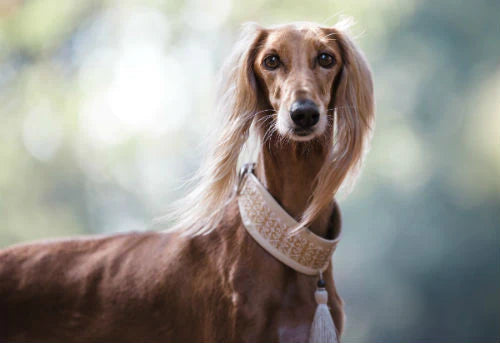
Its figure gives the impression of a delicate dog, due to its elegance and beauty. However, it is a strong dog, with a slender and symmetrical body. It has a fine silhouette that gives it a certain aristocratic appearance, but at the same time, this same physical quality gives it great speed and ease of movement.
Its body is taller than it is long and has formidable proportions, athletic par excellence and a reserved character, making it a quite characteristic dog. Some of the most important details of your physical appearance with:
Weight and size
A characteristic aspect of the breed is its size and weight, since the standard itself does not establish specific measurements, highlighting that it can vary depending on the variant. However, estimates are established in relation to size, ranging between 58 and 70 centimeters in height at the withers. In some cases the females are usually smaller than the males.
The same thing happens with weight, and it can be very varied, ranging from 18 to 27 kilos. This indicates that these are not robust dogs. However, they are strong, which is demonstrated in their athletic and well proportioned body.
It is necessary to strictly maintain this dog breed at its ideal weight, because an exaggerated increase in weight can prevent it from developing normally in its activities and taking full advantage of its abilities.
head
The head is also attractive at first glance. A strong and hard skull, although thin and wedge-shaped forward. Its eyes are oval-shaped, brown, medium in size. Its ears are long, flat and thin, although covered by abundant and thick fur that can be curious. Set high but falling past the cheeks.
His nose is large, pronounced and black. While its mouth is thin and small, although with strong and sharp teeth, whose pincer-shaped bite makes the process of hunting its prey easier.
Queue
The tail of these canines is thin and elongated. Set low, and lightly covered by its fur. It also has a pronounced curve at the tip that can be easily seen.
Fur
This breed is characterized by having two variants: long-haired and short-haired. Both canines have the same physical characteristics mentioned above, differing only in the length and abundance of their fur. However, both are soft, silky and manageable, in addition to having the advantage that they lose very little hair.
Salukis with long and abundant fur can be seen with a type of fringe in specific areas such as the tail and legs. While the one with a smooth and short canvas usually remains slightly uniform. Although in their puppy stage the coat of these canines is usually more prominent than in their adulthood.
Hair colors are also widely varied: white, black, beige, cream, red, tan and gold. In some cases, tricolor combinations or a mixture of several of these colors are accepted.
Saluki Behavior
Just like her beauty, Its character is also usually an attractive aspect to consider as a pet.. It is a calm, reserved and peaceful dog, but above all intelligent.
Loyalty is a virtue that this dog has developed remarkably. And although he appears to be an independent canine, he greatly appreciates family time and playing with the people closest to his environment, although he is not commonly given to displays of affection.
He is friendly and calm. However, in the presence of strangers, they usually appear quiet and alert, without being aggressive. And although it is a pleasant canine, it is not known for being patient, that is, it is not recommended as a pet in homes with children because its reaction to the behavior of the little ones is unknown.
The same thing happens with the presence of other pets, especially if they are smaller species. We must remember that it has a hunting instinct, which can make it difficult for the dog to adapt to its presence, without awakening in it the desire to chase to go after what it sees as prey.
Within this context, socialization is a topic of great importance, as it is what will determine the character that these canines develop with other people and animals.
Education
As we have already mentioned, this is an intelligent dog, meaning training may not be so complicated. However, dedication to this aspect is transcendental. With adequate education and, above all, socialization, these canines will be able to shape their character in an appropriate and balanced way.
In addition, it must be remembered that this is an independent canine; sometimes it may consider itself to be in command and not obey the orders that its guardian gives it. If necessary, it is advisable to receive the guidance and help of a person with experience in dog training, to know the most appropriate ways to train a dog like this.
Some important tips are not to forget positive reinforcement, most canines respond more favorably to aspects such as recognition, motivation and reward, than to traditional training based on shouting and other techniques.
It is also important that the process of education and socialization They occur from an early age, so that the dog develops appropriate behavior from puppyhood to adulthood.
Likewise, the sessions should be short, they should not exceed 20 minutes. In this way the canine will tolerate each of the training without feeling forced or obligated and will respond more effectively to each of them.
Health
Although they are resistant dogs due to their origins in deserts and other hostile environments, this breed has had a tendency to develop different diseases that have considerably affected their well-being.
From eye disorders of different levels of severity, to being canines susceptible to cancer, these dogs can develop, especially in adulthood, this terrible disease.
In addition, it has been discovered that they are one of the few dog breeds that can develop psychosomatic disorders, caused mainly by stress. And they are also prone to developing allergies to medications.
However, with timely care and periodic visits to the veterinarian it is possible to prolong the health of these canines beyond 12 years of life, which is the average longevity best known so far among them.
Saluki Care
Given the considerable list of diseases that can affect the health of the canine, it is important that it maintain a list of basic care by its owners, in this way its health and physical and emotional well-being will remain healthy and its life expectancy will be much longer.
Some of the basic care that this canine requires They are based on food, hygiene and exercise. Below we will show each of them in more detail:
Hygiene
Although it is a breed with shiny and silky hair, which sheds little, it is important to regularly brush its coat. At least once every two days will be enough time to maintain the shine of your canvas.
In relation to bathing, it is recommended to do it monthly or when the dog really deserves it. On the other hand, because they are not tolerant of low temperatures, especially those with short hair, it is important to consider this aspect and take the necessary precautions when bathing them during this temperature of the year.
Food
Feeding these canines is just as important as any other care. Due to their fine figure, they do not require a large amount of food per day, but they do need to be provided with quality feed that can provide them with the necessary nutrients to stay healthy and strong.
Exercise
A high level of energy requires a high level of exercise to maintain proper balance. For this reason, these dogs are not recommended to live in apartments with limited space, since by not having anywhere to release their energy, they will feel limited and may suffer from anxiety due to confinement, or stress, and adopt negative behaviors.
It is important that, in addition to having a considerable space, they receive days of long walks, where they spend at least two hours a day. Days that, complemented with exercises and games, can promote their skills in a positive way.
Saluki vaccination and deworming
The health of the Saluki must be strictly cared for. Therefore, compliance with vaccination and deworming schedules must be very necessary and strictly taken into account.
In addition, visits to the veterinarian should be regular, at least every three to six months. It is important that these steps are considered essential if you want to keep the dog in good health.
To summarize
The Saluki is a pleasant dog for company or for activities such as hunting or long races, this is how this greyhound is defined. Although he is still little known in different countries, his beauty and impetuosity have allowed him to rise in popularity, especially in his country of origin, where he is considered a symbol of honor.
This dog breed has a special character, calm and cautious, combined with a look that reveals elegance and gentleness. However, it is a very self-confident and energetic animal that can reach up to 50 kilometers per hour in a race.
It is important not to get carried away only by the energy and strength of these canines, as they require considerable and important care if you want to prevent them from being affected by different pathologies associated with the breed.
Finally, education is another aspect that should not be missed, since it largely depends on whether our greyhound is a canine with a balanced and calm character.
If you liked this article, you will also like these others:
German Shepherd
Doberman
Czechoslovakian Wolfdog
Hachiko
Tosa Inu
Our Blog
White Swiss Shepherd - Know all the details of this elegant dog
by Lobo Azul in Dec 05 2021
If it is about attractive dogs, the Swiss white shepherd It is one of the breeds with the greatest tendency to excel in this characteristic. Its elegant, distinguished and above all impeccable appearance, combined with an exemplary temperament, is what makes this dog so special and well-known.
Size: Big.
Weight: Between 25 and 45kg.
hair type: White, abundant and dense.
Character: Intelligent and obedient.
Health: Has a tendency to be affected by some diseases of greater or lesser severity
Life expectancy: Up to 12 years old.
An excellent pet, loyal, intelligent and independent, these canines are known inside and outside their country of origin for being excellent companions if what you want is an obedient and calm dog. But that's not all, like many other sheepdogs, their ability to lead and perform outdoor work is another innate quality. However, despite all these characteristics, this canine still needs care, attention and, above all, good education to grow in a balanced way, both emotionally and physically. For this reason, in this article we will dedicate ourselves to talking about all the details that will allow you to get to know this beautiful animal. Discover the origin, characteristics, behavior, health and the care you must provide to this breed to maintain its beauty and peculiarity.
Origin of the Swiss White Shepherd
The origin of this shepherd has been entangled in some controversies, especially because of his color. Although its history dates back to the 80s, there were already some references to this breed before, although not recognized by its original name, but under the legacy of german shepherds. Properly, the German Shepherd was a breed that could be accepted in different shades, including white. Well, in Germany in the 1930s the theory began that white coat german shepherds They represented a denigration of the breed, classifying dogs with this coat as inferior, because they were mistakenly considered albinos. While it is true that albino dogs are white, not all shepherds with fur in this shade suffered from this condition, much less the health problems that it entailed. This serious confusion in German society resulted in white shepherds being almost definitively rejected in this country. However, in other parts of the world where the breed was known with great acceptance, the white german shepherd remained without problems.
It did not take long for the controversial situation of the German Shepherd to spread, and by the 1950s, the American Club of the breed would have excluded white specimens from its list. However, in the American Kennel Club, they were still accepted. This whole situation remained throughout that decade, until in the 60s, a North American breeder settled in Switzerland, taking with her her dog named Wolf: a beautiful white specimen whose beauty captured the attention of more than one resident of this country. Later, more Swiss breeders became interested in Wolf and other specimens from the United States and other places in Europe. As a result of this interest, the breed expanded, no longer as a white German Shepherd, but giving way to the White Swiss Shepherd. Recognition of this breed independently began in the Swiss Canine Society. Some time later, the officialization process was carried out by the International Cynological Federation (FCI), where it was recognized, in principle, provisionally. Currently, although it is a little known breed in some parts of the world, has become one of the most appreciated canines in its country of origin, the United States and other European countries. Its beauty, combined with the characteristic temperament of this breed, has caused it to progressively rise in favoritism independently of the German Shepherd.
Physical characteristics
Its appearance can be described by combining two aspects. Firstly, a robust appearance, accompanied by a moderately tall stature, with a strong appearance. Secondly, there is a mysterious, distinguished and elegant figure that provides him with his features and his neat and smooth white fur. However, the physical characteristics of this canine go much further.
Let's see, below, some of its most notable aspects.
Size and weight
According to the standard established for this breed, it has an average height between 60 and 65 centimeters high at the withers. Meanwhile, females manage to reach from 55 to 60 centimeters. Standing out for being both specimens slightly longer than tall. Its athletic build makes this breed's weight look well distributed, giving it a proportionate and muscular appearance. The average weight that a specimen of this breed can obtain is between 25 and 40 kilos.
head and face
Although it is characterized by having a thin and profiled head, its skull is hard and strong, well proportioned in harmony with its body. Its face, equally outlined, allows each physical feature of this canine to be slightly distinguished. The nose and nasofrontal area are slightly marked but well defined. Its nose is dark in color like its lips, or in some cases it can appear pink, especially in cold weather. For their part, the eyes of these canines are medium-sized, almond-shaped, whose color can vary between brown or dark. Meanwhile, its ears are set high, not very large but characterized by their triangular shape and standing erect, giving the dog a touch of always remaining alert.
Queue
The tail of this canine is long, thin and also covered by its peculiar fur. Low insertion. During its rest, the tail remains hanging. In action, it is possible to observe it upright, in a horizontal position, so it does not protrude above the back of these specimens.
Fur
The fur is undoubtedly a characteristic appearance of the breed, mainly due to its white color, which denotes the neatness of the canine. Another notable aspect is that it is a dog tempered, that is, its fur is divided into two layers. The first of them, the inner layer, is abundant and dense like a type of wool, which helps keep it warm during times of low temperatures. While its outer coat is rougher and smoother. It can be short or medium.
Behavior
In addition to having a characteristic appearance due to its particular coat, its temperament also has details worth mentioning if you want to adopt a specimen of this breed. First of all, It is a dog of great intelligence, a flattering aspect, especially in the area of education, which is undoubtedly essential to maintain appropriate behavior and have a good relationship with your pet. On the other hand, it is an obedient canine, which combined with intelligence, is a positive point when not only training it, but also carrying out processes such as socialization. The loyalty of this breed is something that cannot go unnoticed. Although it is a reserved and independent dog, it is one of the most loyal canines that exist. The company and protection of those he considers his family is essential for these canines. The issue of coexistence can be a bit slow in the case of these dogs. Although they are grazing animals, their personality is reserved and shy, especially in the presence of strangers. In principle, he is likely to remain distant, but attentive to any situation. He will not hesitate to respond in defense of his own if necessary. For this reason, socialization from an early age is essential. Now, with other animals it can be a little more complex due to their herding instinct. However, these canines do not have a tendency to destructive behavior and much less to be aggressive towards other animals. It is about very energetic dogs that love outdoor activities, although they are capable of adapting to any space. This means that they require a large amount of exercise, also complemented with games and various workouts that can be combined to keep the energy they have balanced. In homes with children they are excellent pets, as they are patient, playful and fun. Although it will always be important to educate the little ones about the treatment that the canine should receive and how to behave when being with it.
Training
Because we are talking about an attentive, intelligent and obedient dog, the education of this shepherd will not be a complicated issue. They also have the advantage of adapt easily to any type of training that we choose for him. However, until now the most recommended technique is positive reinforcement. This will not only allow the canine to feel comfortable and happy seeing that you recognize their learning, but it will establish a relationship of empathy and trust with you. Generally, this canine does not present behavioral problems. However, it is not advisable to leave him alone for a long time or do little exercise, as it can alter his energy levels and cause anxiety due to separation or confinement. It is important that socialization takes place from the first weeks of life, once the animal is prepared and properly vaccinated to come into contact with the outside world, in this way, it will establish a close relationship and will be less shy about it. Likewise, basic commands should not be left out of the training process, so the canine will have appropriate behavior and will be an excellent companion.
Health
Compared to many other breeds, this one can be classified as a healthy specimen. However, it has a tendency to be affected by some diseases of greater or lesser severity. Among them, stomach disorders such as gastric torsion, heart disease, skin allergies, hip dysplasia and ophthalmological disorders such as cataracts stand out. For the most part, these diseases can be prevented if the care that the dog requires is taken into consideration. In addition to complying with medical controls where it is possible to promptly detect the appearance of any of these pathologies, adequate deworming and vaccination control must be carried out.
Care
Due to some special characteristics that distinguish this dog breed, it is necessary to rigorously comply with some care to ensure the physical and mental well-being of the White Swiss Shepherd. From medical check-ups, exercises, feeding and hygiene, both this dog and any other pet require the attention of their owners in each of these aspects to maintain a healthy stay and growth. Let's see below some of the most significant care you need:
Swiss White Shepherd Feeding
Although these canines are not prone to obesity, some of the allergies they suffer from may be related to diet. Therefore, it is important that the dog is provided with quality food that provides it with the necessary nutrients to stay healthy. In addition, it is important to control the portions and frequency in which you are fed, combining this with favorable exercise routines to maintain a balance in your physical well-being.
Check out the 5 guidelines for healthy eating in dogs.
Exercises
Although it does not require much space inside the home, this dog needs a large amount of daily exercise. It is a fairly energetic pet, that is, it will need to spend a reasonable amount of time outside the house, for a walk or playing in order to discharge its energy levels. At least two daily walks will be necessary for this specimen to remain calm while hunting. Let's remember that this is a herding dog, so running around in the park is necessary to release all the tension it may accumulate.
Bath and hygiene
It may seem curious, but the coat of this breed does not demand an excessive amount of care. Its beauty is natural, so it will only need two or three brushings a week to avoid knots and remove dirt accumulated on its skin. In relation to bathing, it is not necessary to do this act frequently. A bath every 6 or 8 weeks will be more than enough to keep our specimen cared for and clean. This may vary depending on the dirt and the activities the canine does outside the home. However, on average, with this amount of bathing and brushing, our pet will remain happy and radiant.
Company
It is a reserved and independent dog, but this does not mean that it does not need the company of its own. In fact, this canine loves to spend time with those close to him, and if he is not accompanied for a long time, he may suffer from separation anxiety. This could lead to destructive behaviors that are uncommon in these dogs. If we want to avoid these episodes, it is important to dedicate a few hours a day to walking, playing or simply resting with our dog.
Medical checks
Without a doubt, this point is one of the most important. It is necessary that dates be established from the beginning to carry out veterinary checkups, comply with vaccination and deworming schedules, and maintain medical recommendations as a priority. The well-being of our pet will always be linked to the care we offer and, to achieve this, there is no better way than to follow the specialist's guidelines to the letter.
Conclusion on the Swiss White Shepherd
Although it is a little-known breed today, little by little it is increasing in popularity and gaining followers. Thanks to its character and beauty, it has not been difficult for this species, although it had tough beginnings, to make its way to being a highly sought-after pet. His energy, dynamism, loyalty and intelligence stand out, added to his mysterious but impeccable presence given by the neatness of his coat. However, like any pet, it will require care and attention from its owners. Therefore, it is important that before carrying out the white swiss shepherd adoption, and after having read this article, analyze if you have the time and inclination to properly care for this or any other pet. The happiness and well-being of your future canine will depend on it. Also meet the curious Pachón Navarro.